
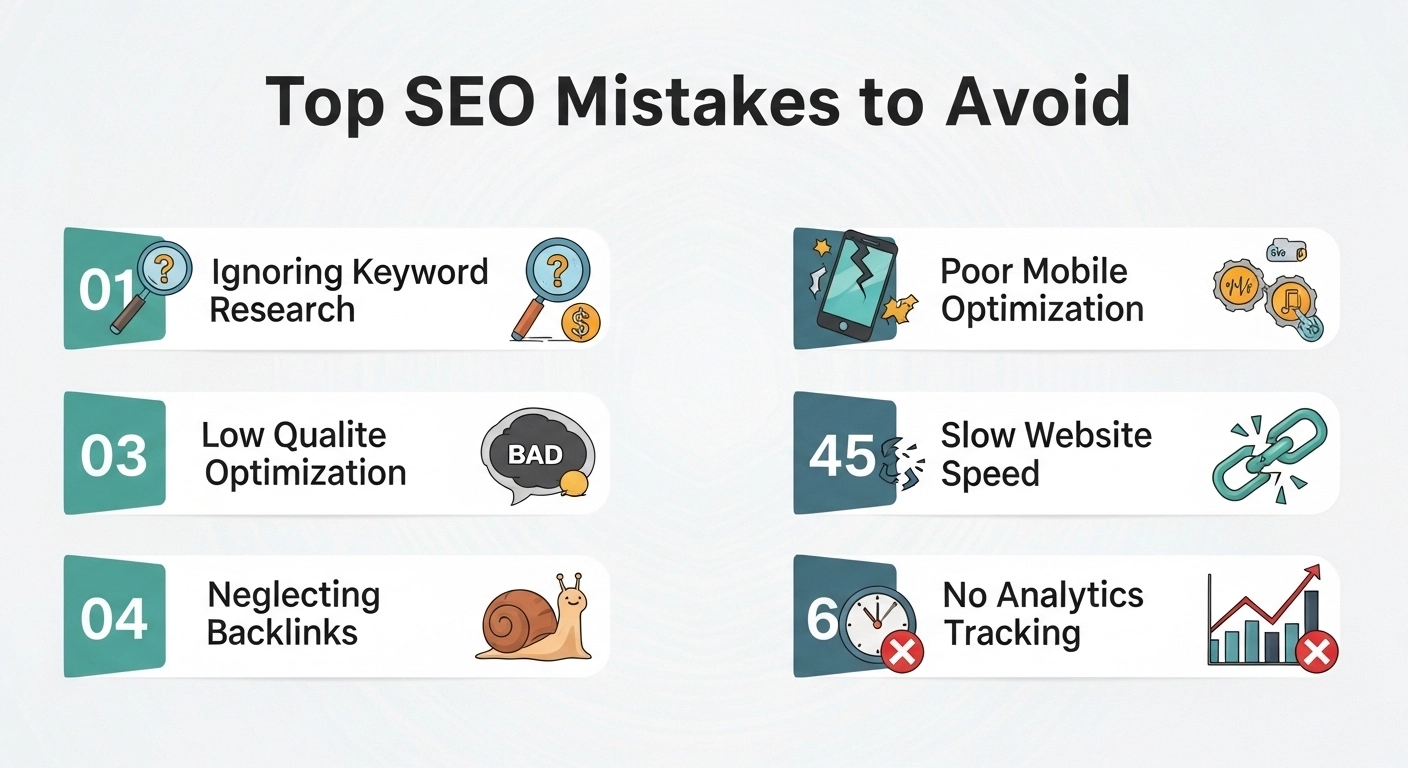
Search engine optimization can drive consistent, high-quality traffic—but only if you avoid the pitfalls that quietly kill rankings. Many sites don’t fail because of competition; they fail because of preventable SEO mistakes.
This guide breaks down the most common SEO errors and shows you exactly how to fix them with practical, real-world examples.
1. Ignoring Search Intent
One of the biggest SEO mistakes is targeting keywords without understanding why users are searching.
The problem
You might rank for a keyword, but if your content doesn’t match intent (informational, transactional, navigational), users will bounce—and rankings will drop.
Example
If someone searches “best SEO tools”, they expect a comparison—not a sales page.
Fix
- Identify intent before writing
- Analyze top-ranking pages
- Match your content format (guide, list, product page)
2. Keyword Stuffing Instead of Natural Optimization
Overusing keywords makes content unreadable and signals low quality to search engines.
The problem
Repeating the same keyword unnaturally harms both UX and rankings.
Fix
- Use variations and synonyms (semantic SEO)
- Focus on readability first
- Include related terms like:
- SEO errors
- ranking factors
- on-page optimization
3. Weak or Missing Title Tags and Meta Descriptions
Your title and meta description are your first impression in search results.
The problem
Generic or missing tags reduce click-through rates.
Fix
- Write compelling, keyword-focused titles
- Keep titles under 60 characters
- Keep meta descriptions around 120–155 characters
- Add a clear benefit or hook
4. Poor On-Page Structure
Messy content confuses both users and search engines.
The problem
No headings, long paragraphs, and no clear structure = lower engagement.
Fix
- Use H1, H2, H3 headings properly
- Keep paragraphs short (2–3 lines)
- Add bullet points and spacing
5. Slow Website Speed
Page speed is a confirmed ranking factor and a major UX signal.
The problem
Slow-loading pages increase bounce rates and reduce conversions.
Fix
- Compress images
- Use caching
- Minimize unnecessary scripts
- Choose fast hosting
6. Not Optimizing for Mobile
Most users browse on mobile devices—Google uses mobile-first indexing.
The problem
A non-responsive site loses rankings and traffic.
Fix
- Use responsive design
- Test across devices
- Ensure buttons and text are mobile-friendly
7. Ignoring Technical SEO
Even great content won’t rank if search engines can’t crawl or index your site properly.
The problem
Issues like broken links, crawl errors, and duplicate content hurt visibility.
Fix
- Fix 404 errors
- Submit XML sitemap
- Use proper robots.txt
- Implement canonical tags
8. Weak Internal Linking
Internal links help search engines understand your site structure and pass authority.
The problem
Orphan pages (no links pointing to them) rarely rank.
Fix
- Link related content naturally
- Use descriptive anchor text
- Build topic clusters
9. Publishing Low-Quality or Thin Content
Content that lacks depth or value won’t rank—period.
The problem
Short, generic posts don’t satisfy users or search engines.
Fix
- Write comprehensive, helpful content
- Answer real user questions
- Add examples, data, and insights
10. Not Updating Old Content
SEO isn’t “publish and forget.”
The problem
Outdated content loses rankings over time.
Fix
- Refresh posts regularly
- Update stats and examples
- Improve structure and add new sections
11. Ignoring Backlinks
Backlinks remain one of the strongest ranking signals.
The problem
Without authority, even great content struggles to rank.
Fix
- Build links through:
- Guest posting
- Outreach
- High-quality content
- Focus on quality, not quantity
12. Skipping Analytics and Tracking
If you don’t measure performance, you can’t improve it.
The problem
You won’t know what’s working—or failing.
Fix
- Use tools like Google Analytics and Search Console
- Track:
- Traffic
- Rankings
- CTR
- Bounce rate
Quick SEO Checklist
Before publishing any page, ask yourself:
- Does it match search intent?
- Is it well-structured and readable?
- Are keywords used naturally?
- Is the page fast and mobile-friendly?
- Are internal links included?
FAQ
What is the most common SEO mistake?
Ignoring search intent. Even well-optimized pages fail if they don’t match what users actually want.
How long does it take to fix SEO mistakes?
It depends, but most improvements (like better content or technical fixes) can show results within a few weeks to a few months.
Does keyword density still matter?
Not really. Focus on natural language and topic coverage instead of repeating keywords.
Can technical SEO alone improve rankings?
It helps, but content quality and backlinks are equally important.
Conclusion
SEO success isn’t about tricks—it’s about avoiding costly mistakes and doing the basics exceptionally well. Focus on user intent, create high-quality content, optimize your site technically, and keep improving over time.
Small fixes can lead to big ranking gains.
