
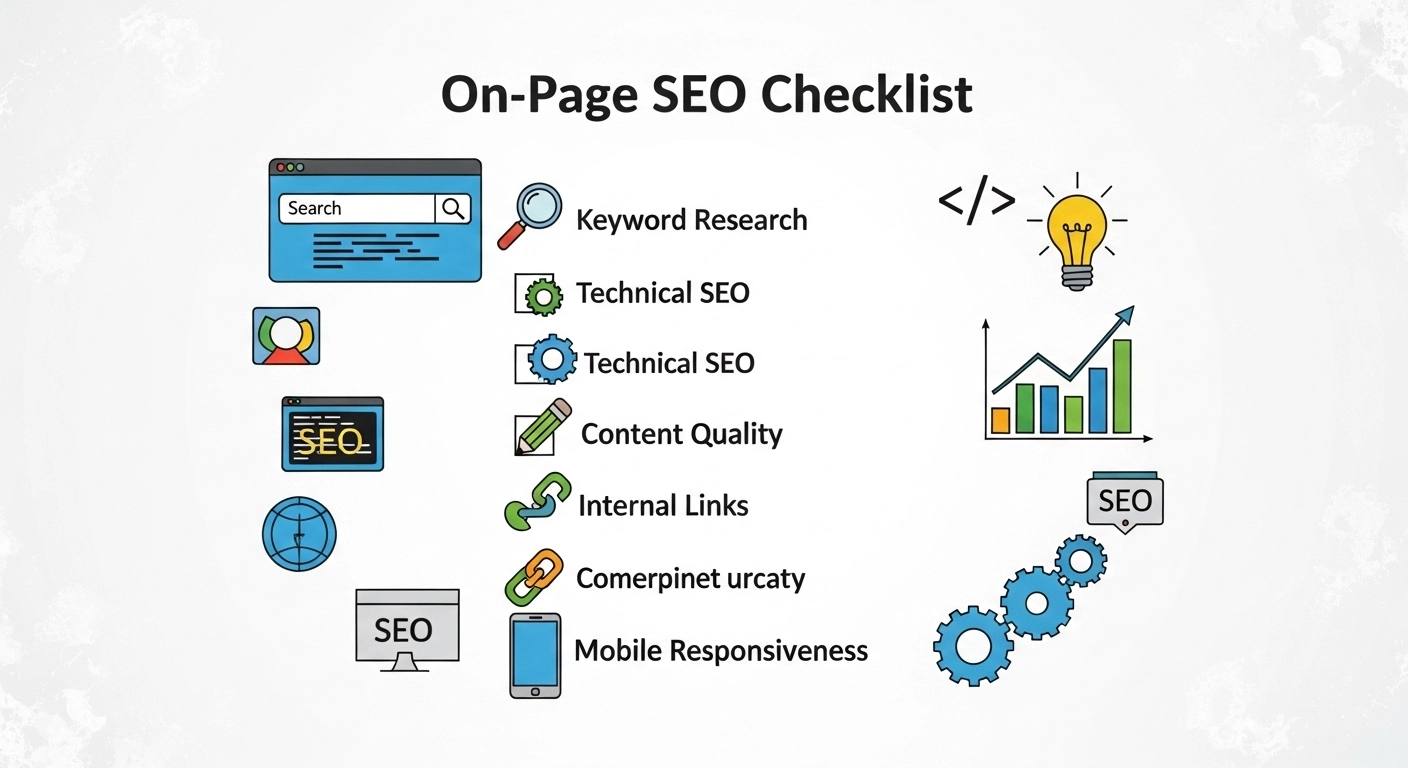
If you want your website to rank on Google, on-page SEO is where it all starts. Before backlinks, before ads, before social media—your pages need to be properly optimized so search engines understand them and users actually stay.
This on-page SEO checklist breaks everything down into clear, actionable steps you can apply to any blog post, landing page, or website.
Let’s get straight into it.
What Is On-Page SEO?
On-page SEO is the practice of optimizing individual web pages to improve search rankings and user experience. It includes everything you control directly on your page, such as:
- Content quality
- Title tags and meta descriptions
- Headings (H1, H2, H3)
- URLs
- Internal links
- Images and alt text
- Page speed and mobile usability
In simple terms: it helps Google understand your page—and helps users trust it.
Complete On-Page SEO Checklist
Use this checklist every time you publish or update a page.
1. Write a Clear, Search-Intent-Focused Title
Your title tag is one of the strongest ranking signals.
Best practices:
- Include your main keyword naturally
- Keep it under 60 characters
- Make it clickable and clear
Example:
❌ “SEO Guide”
✅ “On-Page SEO Checklist: Improve Rankings Step-by-Step”
Your title should instantly tell users what they’ll get.
2. Optimize Your Meta Description
Meta descriptions don’t directly boost rankings, but they improve click-through rates.
Checklist:
- 140–160 characters
- Include the main keyword once
- Add a benefit or promise
Example:
“Use this on-page SEO checklist to optimize your content, improve rankings, and drive more organic traffic with proven strategies.”
3. Use One Strong H1 Tag
Every page should have one clear H1.
Rules:
- Only one H1 per page
- Must include the main keyword
- Should match the page topic closely
This helps both users and search engines understand your content structure.
4. Structure Content with Proper Headings (H2, H3)
Headings improve readability and SEO.
Best structure:
- H1: Main topic
- H2: Major sections
- H3: Subpoints under H2
This also helps Google scan your content faster.
5. Use Keywords Naturally (No Stuffing)
Instead of forcing keywords, focus on semantic relevance.
Include:
- Related terms
- Synonyms
- Contextual phrases
Example for this topic:
- SEO optimization
- search engine ranking
- content structure
- organic traffic
Write for humans first, search engines second.
6. Create High-Quality, Helpful Content
Content quality is still the #1 ranking factor.
Ask yourself:
- Does this solve a real problem?
- Is it better than what’s already ranking?
- Is it easy to understand?
Strong content includes:
- Clear explanations
- Real examples
- Step-by-step guidance
- Updated information
Thin content won’t rank anymore.
7. Optimize URL Structure
Your URL should be clean and readable.
Good URL:
/on-page-seo-checklist
Bad URL:
/page?id=123&seo=abc
Tips:
- Use lowercase
- Keep it short
- Include the keyword
8. Add Internal Links Strategically
Internal links help distribute SEO value and guide users.
Best practices:
- Link to related blog posts
- Use descriptive anchor text
- Avoid overloading links
Example:
“Learn more about keyword research strategies to improve your SEO planning.”
9. Optimize Images (Size + Alt Text)
Images affect both SEO and page speed.
Checklist:
- Compress images for fast loading
- Use descriptive file names
- Add alt text with context
Example:
Alt text: “On-page SEO checklist for optimizing web pages”
This also improves accessibility.
10. Improve Page Speed
A slow website kills rankings and user experience.
Key fixes:
- Compress images
- Use caching
- Minify CSS and JavaScript
- Choose a fast hosting provider
Google prioritizes fast-loading pages.
11. Make Your Page Mobile-Friendly
Most users browse on mobile, so your site must adapt.
Check:
- Responsive design
- Readable font size
- Easy navigation
- No horizontal scrolling
Google uses mobile-first indexing, so this is essential.
12. Add External Links to Trusted Sources
Linking to authoritative sites improves trust.
Best practice:
- Use relevant, high-quality sources
- Open in new tab
- Don’t overdo it
It shows Google your content is well-researched.
13. Improve Readability and User Experience
Even great content fails if it’s hard to read.
Tips:
- Use short paragraphs
- Add bullet points
- Use simple language
- Highlight key points
Good UX = lower bounce rate = better rankings.
14. Optimize for Featured Snippets
Featured snippets can bring huge traffic.
How to target them:
- Answer questions clearly
- Use lists and steps
- Keep definitions short
Example:
“What is on-page SEO?” → Provide a 2–3 sentence direct answer.
15. Add Schema Markup (If Possible)
Schema helps search engines understand your content better.
Common types:
- Article schema
- FAQ schema
- Product schema (for ecommerce)
This can improve visibility in search results.
Simple On-Page SEO Checklist Summary
Here’s a quick recap:
- SEO-friendly title
- Optimized meta description
- One H1 tag
- Proper heading structure
- Natural keyword usage
- High-quality content
- Clean URL
- Internal linking
- Optimized images
- Fast page speed
- Mobile-friendly design
- External links to authority sites
- Good readability
- Featured snippet optimization
- Schema markup
FAQ: On-Page SEO Checklist
1. What is the most important on-page SEO factor?
Content quality and search intent matching are the most important factors.
2. How often should I update on-page SEO?
Review your pages every 3–6 months or when rankings drop.
3. Is keyword density still important?
Not really. Focus on natural usage and related terms instead of exact density.
4. Can I rank without backlinks?
Yes, for low-competition keywords, but backlinks help improve authority and stability.
5. What tools can help with on-page SEO?
Tools like Google Search Console, Ahrefs, and SEMrush are commonly used.
Conclusion
On-page SEO is the foundation of every successful website. If your pages are properly optimized, you don’t just rank higher—you also attract better traffic and keep users engaged longer.
The good news? You don’t need advanced tools or technical skills to get started. Just follow this checklist step by step and apply it consistently.
