
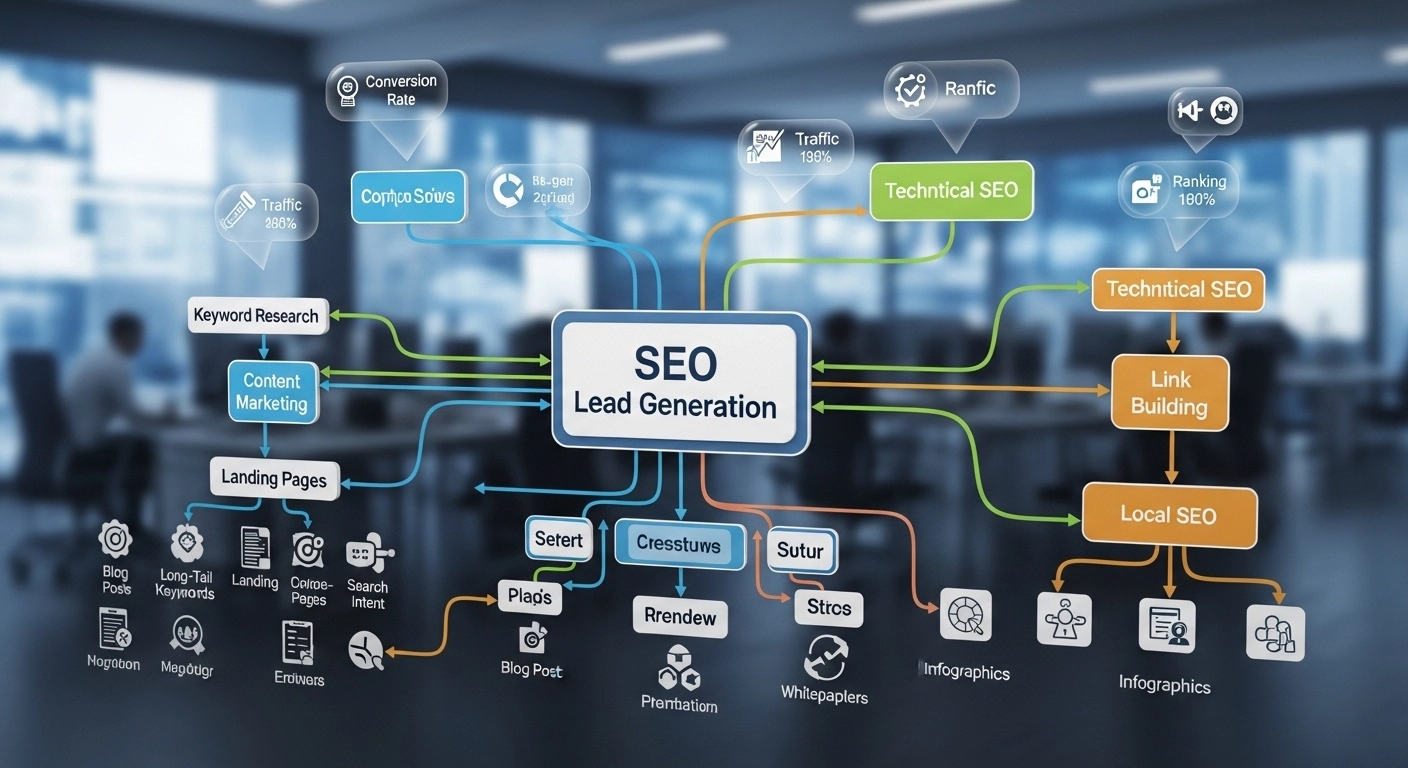
If your website gets traffic but few inquiries, the problem usually isn’t traffic—it’s conversion. A strong SEO lead generation strategy focuses on attracting the right visitors from search engines and guiding them toward becoming potential customers.
This guide explains how to build a reliable SEO system that brings consistent, high-quality leads to your website.
What Is an SEO Lead Generation Strategy?
An SEO lead generation strategy is the process of using search engine optimization to attract people who are actively searching for your products or services and converting them into leads.
A lead can be someone who:
- Fills out a contact form
- Books a consultation
- Subscribes to a newsletter
- Requests a quote
- Downloads a guide or resource
Unlike paid ads, SEO generates long-term organic leads without paying for every click.
Example:
Someone searching “best SEO agency for small business” already has buying intent. If your page ranks for that query and offers a clear solution, that visitor can easily become a lead.
Why SEO Is Powerful for Lead Generation
SEO works well for lead generation because it captures people exactly when they need a solution.
Key advantages include:
1. High Intent Traffic
Users searching on Google usually have a problem they want solved.
2. Long-Term Results
Unlike ads, SEO content can bring leads for months or years.
3. Higher Trust
Organic results are often trusted more than advertisements.
4. Lower Cost per Lead
Once rankings improve, your cost per lead drops significantly.
Step 1: Target the Right Keywords
Lead generation starts with choosing keywords that show commercial or problem-solving intent.
Focus on keywords such as:
- “best CRM for small business”
- “SEO services pricing”
- “how to increase website traffic”
- “local SEO services near me”
These searches often indicate that the user is ready to take action.
Keyword Types That Generate Leads
Problem-based keywords
Example: how to generate leads for real estate
Solution-based keywords
Example: best lead generation tools
Service keywords
Example: SEO agency for ecommerce
Comparison keywords
Example: HubSpot vs Salesforce
Use keyword research tools to identify long-tail keywords with lower competition but strong intent.
Step 2: Create High-Intent Content
Once you identify the right keywords, build content that directly answers the user’s problem.
Types of content that generate leads effectively:
How-to Guides
Example:
“How to Build a Lead Generation Funnel for B2B Companies”
Industry Case Studies
Example:
“How We Increased Organic Leads by 220% in 6 Months”
Comparison Articles
Example:
“Best Email Marketing Platforms for Small Businesses”
Local Service Pages
Example:
“SEO Services in Chicago for Small Businesses”
Each piece of content should help the user solve a problem and take the next step.
Step 3: Optimize for Search Intent
Ranking content isn’t enough. The page must match what the searcher wants.
If someone searches:
“best CRM software”
They expect:
- comparisons
- features
- pricing
- pros and cons
Not a sales pitch.
Align your content structure with search intent by including:
- clear explanations
- helpful lists
- practical examples
- visual breakdowns
When search intent matches perfectly, Google rewards the page with higher rankings.
Step 4: Design Conversion-Focused Pages
Traffic alone does not generate leads. Your page must encourage action.
Key conversion elements include:
Clear Call-to-Action (CTA)
Examples:
- Get a Free SEO Audit
- Request a Demo
- Download the Guide
- Book a Consultation
Place CTAs in multiple positions:
- top of page
- middle of content
- end of article
Simple Lead Forms
Keep forms short. Ask only for essential information.
Example:
Name
Email
Company
Message
The easier the form, the higher the conversion rate.
Lead Magnets
Offer something valuable in exchange for contact information.
Popular lead magnets include:
- free templates
- industry reports
- SEO checklists
- strategy guides
- free tools
Example:
“Download our 2026 SEO Checklist for Free”
Step 5: Build Topical Authority
Google rewards websites that show deep expertise in a topic.
The best way to achieve this is with topic clusters.
Example structure:
Pillar Page
Complete Guide to Lead Generation
Supporting Articles
- Lead generation tools
- SEO for B2B leads
- Local lead generation strategies
- Conversion rate optimization tips
Interlink these pages together. This helps search engines understand that your website is an authority on lead generation.
Step 6: Capture Local SEO Leads
For service businesses, local SEO is extremely powerful.
Optimize for keywords like:
- plumber in Dallas
- digital marketing agency in New York
- dentist near me
Steps to improve local lead generation:
- optimize Google Business Profile
- collect customer reviews
- build local citations
- create city-specific landing pages
Local searches often convert at very high rates.
Step 7: Track and Improve Conversions
A strong SEO lead generation strategy always includes measurement.
Track metrics like:
- organic traffic
- keyword rankings
- form submissions
- conversion rate
- leads per page
Tools commonly used include:
- Google Analytics
- Google Search Console
- heatmaps
- conversion tracking tools
Identify which pages bring the most leads and expand similar content.
Practical Example of SEO Lead Generation
Imagine a digital marketing agency.
Instead of targeting only broad keywords like:
“SEO”
They create targeted pages such as:
- “SEO services for dentists”
- “Local SEO for law firms”
- “How dentists can get more patients from Google”
Each page attracts a specific audience with a clear need, making it easier to convert visitors into leads.
Common SEO Lead Generation Mistakes
Many websites fail because of these common issues:
Targeting only high-volume keywords
Traffic without intent rarely converts.
Weak calls-to-action
Visitors need a clear next step.
Slow website speed
Slow pages reduce conversions dramatically.
No internal linking
Visitors leave instead of exploring more content.
Ignoring mobile users
Most searches now happen on mobile devices.
Fixing these mistakes can dramatically increase lead generation.
FAQ: SEO Lead Generation Strategy
How long does SEO take to generate leads?
Most SEO strategies start producing noticeable leads within 3 to 6 months, depending on competition, website authority, and content quality.
What type of content generates the most leads?
Content with high buying intent, such as comparison articles, service pages, and case studies, usually converts the best.
Is SEO better than paid ads for lead generation?
SEO and paid ads work best together. However, SEO often delivers lower long-term cost per lead because organic traffic continues even without ongoing ad spend.
Do small businesses benefit from SEO lead generation?
Yes. In fact, SEO is one of the most effective marketing channels for small businesses because it attracts local customers who are already searching for their services.
Conclusion
An effective SEO lead generation strategy goes far beyond ranking for keywords. It combines smart keyword targeting, helpful content, strong search intent alignment, and conversion-focused page design.
When these elements work together, your website becomes more than just an information source—it becomes a consistent lead generation engine.
Businesses that invest in SEO today are building a long-term pipeline of qualified prospects searching for their solutions.
