
If people can’t find your website, your marketing efforts won’t work—no matter how good your product or content is. That’s where an SEO marketing visibility strategy comes in.
SEO visibility is about making your website appear in search results when people look for information, products, or services related to your business. A strong strategy helps your pages rank higher, reach the right audience, and drive consistent organic traffic.
In this guide, you’ll learn what SEO visibility means, why it matters, and how to build a practical strategy that improves your presence in search engines.
What Is an SEO Marketing Visibility Strategy?
An SEO marketing visibility strategy is a structured plan designed to increase how often and how prominently your website appears in search engine results.
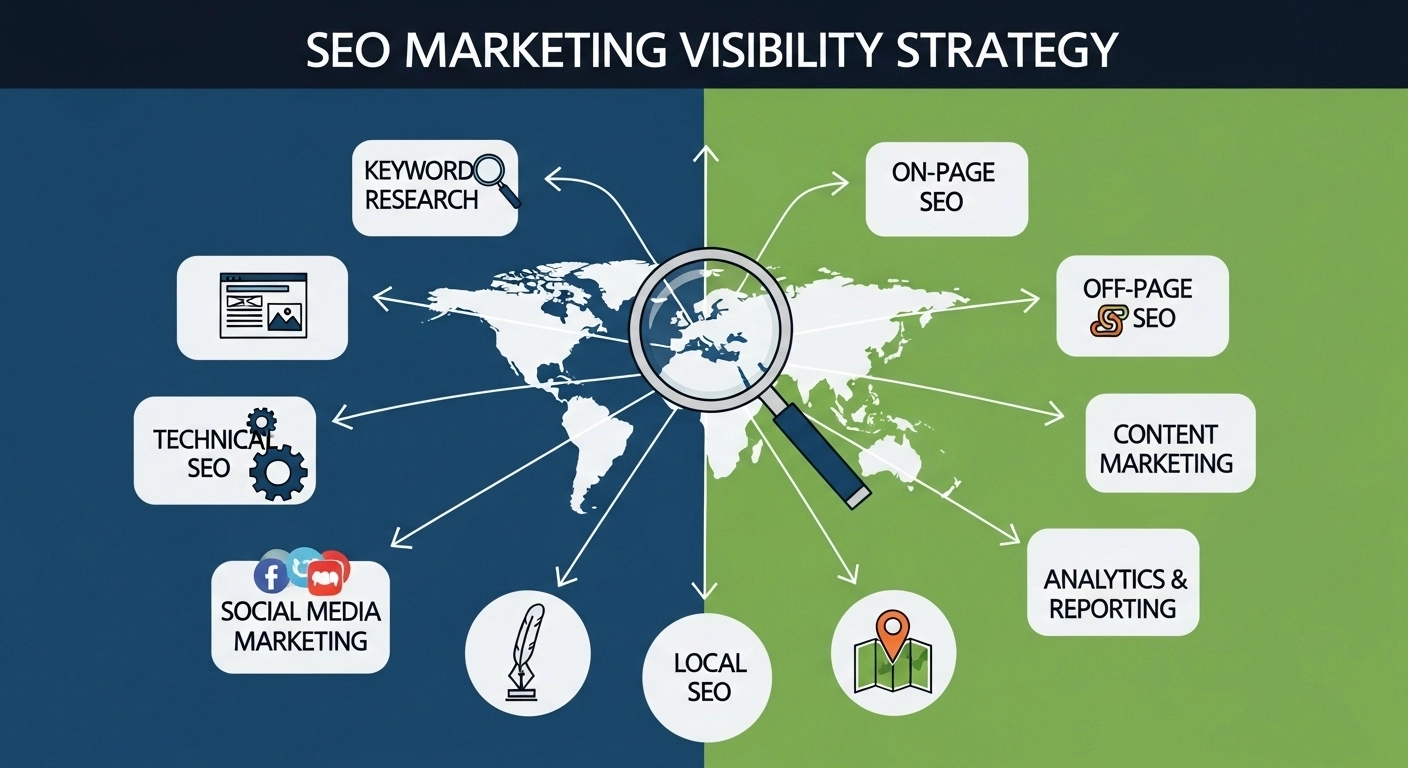
It combines several SEO practices, including:
- Keyword research
- Content optimization
- Technical SEO improvements
- Internal linking
- Authority building through backlinks
The goal is simple: make your content easy for search engines to understand and valuable for users to find.
When done correctly, your website becomes more visible for relevant searches, bringing in qualified traffic without paying for ads.
Why SEO Visibility Matters for Online Growth
Search engines are often the first place people go when they need answers, products, or services.
Improving your SEO visibility can lead to:
More organic traffic
Higher rankings bring more clicks from search results.
Better brand awareness
Appearing frequently in search results builds trust and recognition.
Higher-quality leads
Users who find you through search usually have clear intent.
Long-term marketing results
Unlike paid ads, SEO traffic continues even after the content is published.
In short, visibility turns your website into a consistent traffic and lead-generation channel.
Key Elements of a Strong SEO Visibility Strategy
A successful SEO marketing plan relies on several core components working together.
1. Smart Keyword Research
Keyword research helps you understand what your audience is searching for.
Focus on:
- Search intent (informational, commercial, transactional)
- Long-tail keywords
- Topic clusters
- Low-competition opportunities
Example:
Instead of targeting a broad keyword like “SEO,” you might target “SEO marketing visibility strategy for small business.”
These longer phrases often convert better because they match specific user needs.
2. High-Quality, Intent-Focused Content
Content is the backbone of search visibility.
Your articles should:
- Answer real user questions
- Be easy to read
- Include relevant keywords naturally
- Provide practical value
Search engines prioritize content that fully satisfies user intent.
For example, a strong article will include explanations, examples, steps, and FAQs instead of just brief definitions.
3. On-Page SEO Optimization
On-page SEO helps search engines understand your content.
Important elements include:
Title tags
Use your main keyword near the beginning.
Meta descriptions
Write compelling summaries that encourage clicks.
Header structure (H1, H2, H3)
Organize content clearly for both readers and search engines.
Internal links
Link related pages together to strengthen topic relevance.
Image optimization
Use descriptive alt text and compress images for faster loading.
4. Technical SEO Improvements
Even great content won’t rank well if the website has technical problems.
Important technical factors include:
- Fast page speed
- Mobile-friendly design
- Secure HTTPS connection
- Clean URL structure
- Proper indexing in search engines
Technical SEO ensures that search engines can crawl and understand your site easily.
5. Topic Clusters and Content Authority
Search engines increasingly reward topical authority.
Instead of publishing random articles, build topic clusters around one main subject.
Example:
Pillar Page:
SEO Marketing Strategy
Cluster Articles:
- Keyword research for SEO
- On-page SEO checklist
- Technical SEO basics
- Internal linking strategies
- SEO content optimization
This structure signals to search engines that your website is an authority on the topic.
6. Backlinks and Website Authority
Backlinks—links from other websites—are still one of the strongest ranking signals.
Quality backlinks show search engines that your content is trustworthy.
Ways to earn backlinks include:
- Guest posting
- Publishing original research
- Creating helpful guides
- Building relationships with industry websites
Focus on quality over quantity.
Measuring SEO Visibility
To know whether your strategy works, track key SEO metrics.
Important metrics include:
- Keyword rankings
- Organic traffic growth
- Click-through rate (CTR)
- Domain authority
- Number of indexed pages
Tools like Google Search Console and Google Analytics can help monitor these results and identify improvement opportunities.
Practical Example of an SEO Visibility Strategy
Imagine a small digital marketing agency launching a blog.
Instead of writing random posts, they build a strategy like this:
- Research keywords related to SEO and digital marketing.
- Create a pillar page called “Complete SEO Guide for Beginners.”
- Publish supporting articles on keyword research, on-page SEO, and site speed.
- Link all articles together internally.
- Promote the content through guest posts and partnerships.
Over time, search engines recognize the website as a reliable source of SEO knowledge, improving rankings and visibility.
Common Mistakes That Reduce SEO Visibility
Many websites struggle with visibility because of avoidable mistakes.
These include:
- Publishing thin or low-quality content
- Ignoring search intent
- Using too many keywords unnaturally
- Poor internal linking structure
- Slow website speed
Avoiding these issues can significantly improve your chances of ranking higher.
Frequently Asked Questions
What does SEO visibility mean?
SEO visibility refers to how often and how prominently a website appears in search engine results for relevant keywords.
How long does it take to improve SEO visibility?
Most websites start seeing noticeable improvements within 3 to 6 months, depending on competition, content quality, and consistency.
What is the most important factor for SEO visibility?
High-quality content that matches search intent is one of the most important factors, supported by strong technical SEO and backlinks.
Is SEO better than paid advertising?
SEO and paid ads serve different purposes. SEO delivers long-term organic traffic, while paid ads provide immediate but temporary visibility.
Final Thoughts
An effective SEO marketing visibility strategy isn’t about chasing quick rankings—it’s about building a system that consistently attracts the right audience.
By combining keyword research, high-quality content, on-page optimization, technical improvements, and authority building, you can significantly increase your presence in search results.
The websites that succeed in SEO are the ones that focus on helping users first and optimizing for search engines second.
