
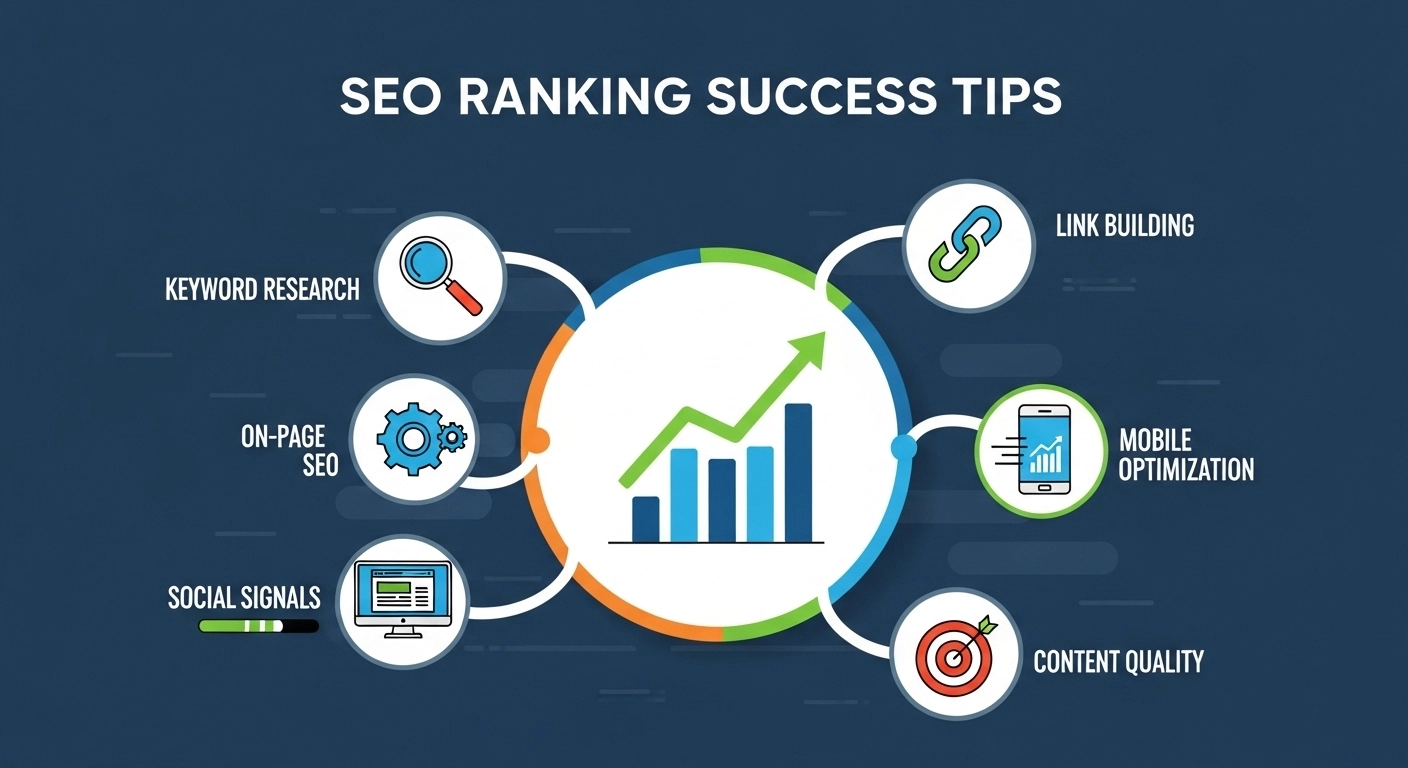
Getting your website to rank on Google isn’t about luck. It’s about using the right strategies consistently. Many websites publish content every day, but only a small percentage actually reach the top of search results.
If you want real SEO ranking success, you need a clear plan: strong content, technical optimization, and a user-first approach. In this guide, you’ll learn practical SEO ranking success tips that help websites increase visibility, attract traffic, and grow online.
Understand Search Intent First
Before writing any content, you must understand why people search for a keyword. This is called search intent.
There are four common types of search intent:
Informational – users want to learn something
Navigational – users want to find a specific website
Commercial – users compare products or services
Transactional – users are ready to buy
For example, someone searching “SEO ranking success tips” wants practical advice they can apply immediately.
To match search intent:
Study the top 10 Google results
Identify what type of content ranks (guides, lists, tutorials)
Structure your article to provide deeper value
Content that matches search intent almost always ranks better.
Do Smart Keyword Research
Successful SEO always starts with the right keywords.
Instead of targeting only competitive keywords, focus on long-tail keywords. These are longer phrases with clear intent and lower competition.
Examples related to this topic include:
how to improve SEO rankings
SEO tips for beginners
Google ranking factors
on-page SEO checklist
technical SEO improvements
Good keyword research tools include:
Google Keyword Planner
Ahrefs
SEMrush
Ubersuggest
Once you find the right keywords, naturally include them in headings, subheadings, and body text.
Write High-Quality Content That Solves Problems
Google’s main goal is simple: show the best answer to the user’s question.
That means your content must be:
Clear
Helpful
Original
Easy to read
Use short paragraphs, simple language, and clear headings.
Instead of writing generic advice, include practical examples.
Example:
Bad advice:
“Improve your content quality.”
Better advice:
“Write detailed guides that answer all user questions in one place. For example, instead of a 500-word article on SEO tips, publish a complete 2000-word guide covering keyword research, on-page SEO, technical SEO, and link building.”
Helpful content naturally earns better rankings.
Optimize Your On-Page SEO
On-page SEO helps search engines understand your content.
Focus on these key elements.
Title Tag
Your title should include the main keyword and encourage clicks.
Example:
SEO Ranking Success Tips: 10 Proven Ways to Rank Higher on Google
Meta Description
Write a short summary that makes users want to click your page.
Example:
Learn proven SEO ranking success tips to increase traffic, improve search visibility, and grow your website faster.
Headings
Use clear heading structure.
H1 for the main title
H2 for main sections
H3 for subtopics
This improves readability and SEO.
Internal Links
Link to other relevant pages on your website. This helps Google understand your site structure and keeps visitors engaged longer.
Improve Website Speed
Page speed is an important ranking factor.
Slow websites increase bounce rate and reduce user satisfaction.
Ways to improve speed include:
Compress images
Use fast web hosting
Enable browser caching
Minimize unnecessary plugins
Use a content delivery network (CDN)
A faster website provides a better user experience and improves rankings.
Make Your Website Mobile Friendly
More than half of web traffic comes from mobile devices. Google also uses mobile-first indexing, meaning it evaluates the mobile version of your website first.
Make sure your website:
Loads quickly on mobile
Has readable text without zooming
Uses responsive design
Has easy navigation
Mobile optimization directly affects SEO performance.
Build High-Quality Backlinks
Backlinks are links from other websites pointing to your site. They act like votes of trust in the eyes of search engines.
However, quality matters more than quantity.
Effective backlink strategies include:
Guest posting on relevant blogs
Creating shareable content
Publishing research or data
Building relationships with industry websites
Avoid buying spammy backlinks. Low-quality links can harm your rankings.
Focus on User Experience (UX)
Google tracks how users interact with your content.
If visitors leave your site quickly, rankings can drop.
Improve user experience by:
Using clear formatting
Adding images and visuals
Breaking content into sections
Providing easy navigation
The easier your content is to read and understand, the better it performs in search results.
Update Your Content Regularly
SEO is not a one-time task. Search trends change, competitors publish new content, and Google updates its algorithms.
Updating content helps maintain rankings.
Content updates may include:
Adding new information
Improving outdated sections
Including new keywords
Updating statistics and examples
Fresh content signals relevance to search engines.
Track Your SEO Performance
Successful websites track results and improve over time.
Important tools include:
Google Search Console – track rankings and indexing
Google Analytics – analyze traffic and user behavior
SEO tools like Ahrefs or SEMrush – monitor keywords and backlinks
Tracking performance helps you understand what works and where improvements are needed.
Frequently Asked Questions
How long does SEO take to show results?
SEO usually takes 3 to 6 months to show noticeable results. Competitive industries may take longer, while low-competition niches can rank faster.
What is the most important SEO ranking factor?
High-quality content that matches search intent is one of the most important factors. Backlinks, page speed, and on-page optimization also play major roles.
Are backlinks still important for SEO?
Yes. Backlinks remain one of the strongest ranking signals. However, links must come from relevant and trustworthy websites.
Can beginners learn SEO easily?
Yes. Beginners can start by learning keyword research, on-page SEO, and basic technical optimization. With consistent practice, SEO skills improve quickly.
Conclusion
Achieving strong search rankings requires more than publishing random content. Real SEO success comes from a combination of keyword research, high-quality content, technical optimization, and a great user experience.
Focus on helping users, answering their questions better than competitors, and continuously improving your website. Over time, these SEO ranking success tips can significantly increase your visibility, traffic, and online growth.
