
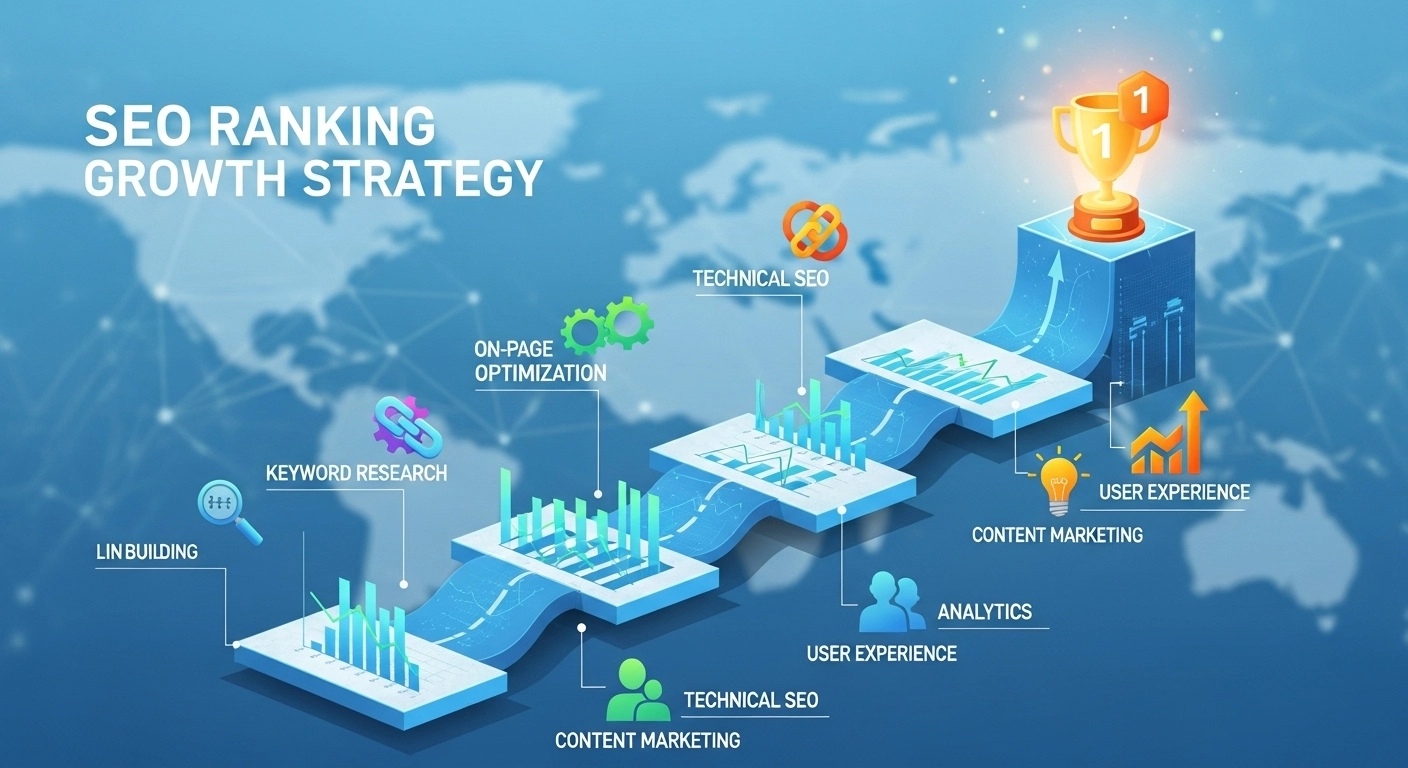
If your website isn’t growing in Google search results, the problem usually isn’t one single thing. Strong SEO growth happens when content quality, technical health, and user experience work together.
A smart SEO ranking growth strategy focuses on building authority, improving website structure, and publishing content that truly answers search intent.
In this guide, you’ll learn the exact steps businesses and bloggers use to grow rankings consistently.
1. Start With Smart Keyword Research
Every SEO strategy begins with understanding what people actually search for.
Instead of targeting only high-volume keywords, focus on search intent and long-tail opportunities. These keywords are easier to rank for and bring highly targeted traffic.
Example:
Instead of targeting:
“SEO”
Try targeting:
“SEO ranking growth strategy for new websites”
Helpful keyword types include:
Informational keywords (how to improve SEO ranking)
Long-tail keywords (SEO strategy for small businesses)
Question-based keywords (how does Google rank websites)
Tools commonly used for research include keyword tools, search suggestions, and competitor analysis.
2. Create High-Quality, Search-Intent Content
Google ranks pages that solve the user’s problem better than other results.
That means content must be:
Clear and easy to read
Well structured with headings
Updated and accurate
Helpful and practical
A strong SEO article typically includes:
A clear introduction
Organized H2 and H3 headings
Real examples
Internal links to related pages
Optimized images
Example structure:
Title
Introduction
Main strategy sections
Examples and tips
FAQ section
Conclusion
Content that follows this structure tends to rank better because it improves user experience and readability.
3. Build Topic Authority With Content Clusters
Modern SEO focuses on topical authority, not just single keywords.
Instead of publishing random articles, build content clusters around one main topic.
Example:
Pillar Topic: SEO Strategy
Supporting Articles:
Keyword research guide
On-page SEO checklist
Technical SEO audit
Internal linking strategy
SEO content writing tips
All articles link to each other and the main pillar page.
This structure helps search engines understand that your website is an expert resource on the topic.
4. Improve On-Page SEO
On-page SEO helps search engines understand your page content.
Key optimization areas include:
SEO Title
Include the main keyword naturally.
Example:
SEO Ranking Growth Strategy: 7 Proven Ways to Increase Search Traffic
Meta Description
Write a compelling description that encourages clicks.
Headings (H1, H2, H3)
Break content into sections for better readability.
Internal Links
Link to other helpful pages on your site.
Image Optimization
Use descriptive file names
Add alt text
Compress images for faster loading
These improvements help both search engines and users navigate your content easily.
5. Strengthen Technical SEO
Even great content struggles to rank if a website has technical problems.
Important technical SEO factors include:
Fast page loading speed
Mobile-friendly design
Secure HTTPS connection
Clean site architecture
Proper indexing in search engines
Simple improvements like optimizing images and reducing unnecessary plugins can dramatically improve site performance.
6. Build High-Quality Backlinks
Backlinks remain one of the strongest ranking signals.
A backlink is when another website links to your page. Search engines treat this as a vote of trust.
Effective link-building strategies include:
Writing guest posts
Creating research-based content
Publishing helpful guides
Building relationships with other websites
Focus on quality over quantity. One link from a trusted website is often more valuable than dozens of weak links.
7. Track Performance and Improve Content
SEO growth requires ongoing improvement.
Monitor key metrics such as:
Keyword rankings
Organic traffic
Click-through rate (CTR)
Bounce rate
Indexed pages
If a page is ranking on page two of Google, small improvements like better headings, updated data, and stronger internal links can push it onto page one.
SEO is not a one-time task — it’s a continuous optimization process.
Simple SEO Growth Example
Imagine a new website publishing a complete SEO guide.
Within a few months, the site starts gaining consistent organic traffic and stronger rankings.
Frequently Asked Questions
What is an SEO ranking growth strategy?
An SEO ranking growth strategy is a long-term plan focused on improving search visibility through better content, technical optimization, keyword targeting, and backlinks.
How long does SEO growth take?
SEO results usually appear within 3 to 6 months, depending on competition, content quality, and website authority.
What is the most important SEO ranking factor?
There is no single factor, but high-quality content combined with strong backlinks and good technical SEO has the biggest impact.
Can a new website rank on Google?
Yes. New websites can rank by targeting long-tail keywords, publishing helpful content, and building topical authority over time.
Conclusion
Growing your website in search results doesn’t happen overnight. A successful SEO ranking growth strategy focuses on the fundamentals: smart keyword research, high-quality content, strong technical SEO, and authoritative backlinks.
When these elements work together, search engines begin to recognize your website as a trusted resource — and rankings improve naturally.
