
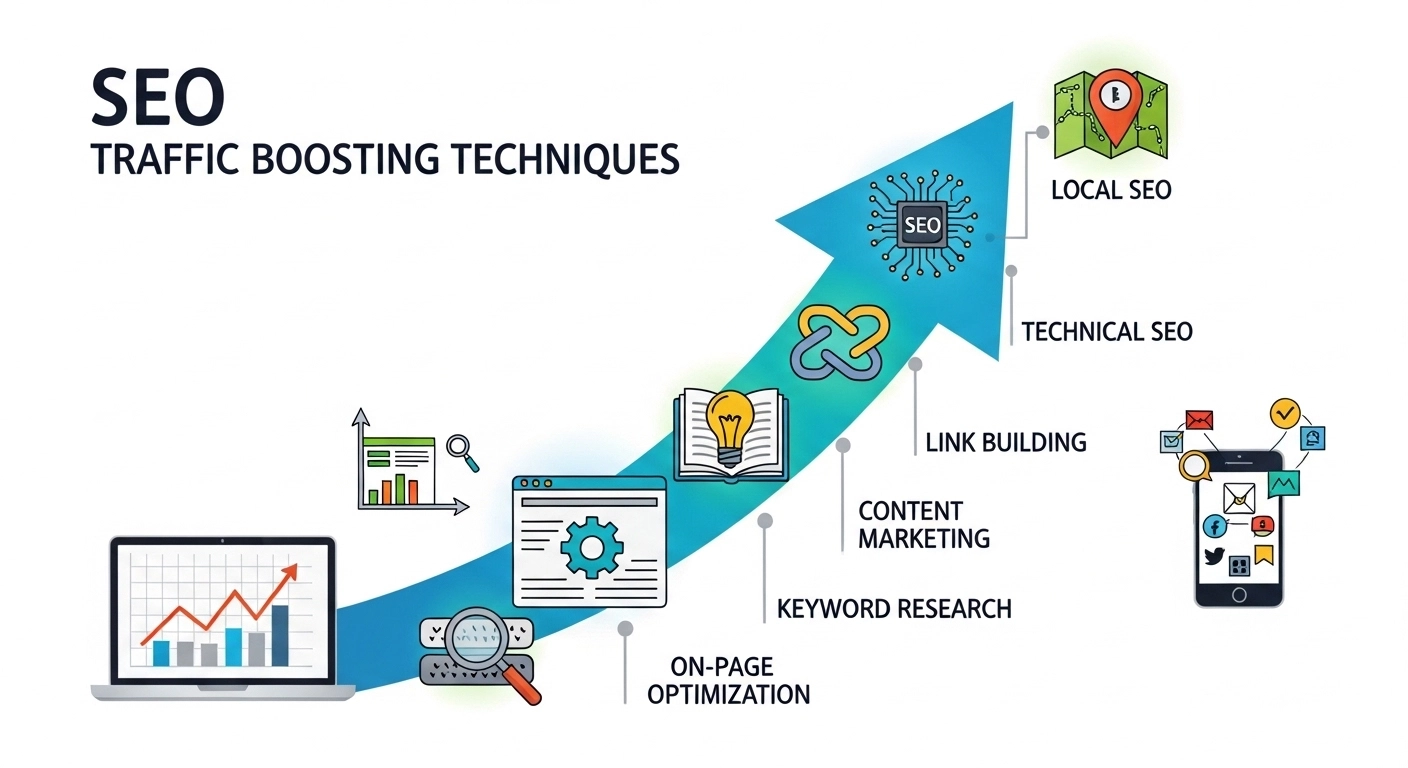
Getting traffic from search engines isn’t about tricks or shortcuts anymore. Modern SEO is about helping users find exactly what they’re looking for. If your website solves real problems and is optimized correctly, Google will reward it with more visibility.
In this guide, you’ll learn practical SEO traffic boosting techniques you can start using today to grow organic traffic and improve rankings.
1. Target Search Intent, Not Just Keywords
One of the biggest mistakes in SEO is focusing only on keywords. What really matters is search intent—the reason behind a search.
There are four main types of search intent:
- Informational: Users want information (e.g., “how to improve SEO traffic”)
- Navigational: Users want a specific website
- Commercial: Users are comparing options
- Transactional: Users are ready to buy
Example
If someone searches “SEO traffic boosting techniques,” they expect a practical guide with strategies—not a sales page.
Tip:
Before writing content, search your keyword in Google and analyze the top results. Match the format, depth, and intent.
2. Focus on Long-Tail Keywords
Long-tail keywords are longer, more specific search phrases. They usually have lower competition but higher conversion rates.
Examples:
- SEO traffic boosting techniques
- how to increase organic traffic fast
- best SEO strategies for small websites
- beginner SEO traffic tips
Instead of targeting one broad keyword, build content around multiple related phrases.
Benefit:
One well-optimized article can rank for dozens or even hundreds of search queries.
3. Create High-Quality, Problem-Solving Content
Content is still the foundation of SEO.
But today, depth and usefulness matter more than volume.
Great SEO content should:
- Answer the user’s question clearly
- Include examples and actionable tips
- Be easy to read and well-structured
- Provide more value than competing pages
Simple Content Formula
Problem → Explanation → Solution → Example
For instance:
- Explain why traffic is low
- Show common SEO mistakes
- Provide step-by-step improvements
The goal is to become the best result on Google for that topic.
4. Optimize On-Page SEO
On-page SEO helps search engines understand your content.
Make sure your page includes:
Title Tag
Include your main keyword naturally.
Example:
10 SEO Traffic Boosting Techniques to Increase Organic Visitors
Headings (H1, H2, H3)
Break content into sections for readability.
Meta Description
Write a compelling summary to improve click-through rate.
Keyword Placement
Use your keyword in:
- Title
- First paragraph
- Headings
- Image alt text
- URL
But keep it natural—never force keywords.
5. Improve Website Speed
Page speed directly affects both SEO rankings and user experience.
Slow websites cause visitors to leave quickly, which increases bounce rate.
Ways to improve speed:
- Compress images
- Use fast hosting
- Enable browser caching
- Minimize scripts and plugins
Tools you can use:
- Google PageSpeed Insights
- GTmetrix
- Lighthouse
Even a 1–2 second speed improvement can increase traffic and engagement.
6. Build Internal Links
Internal linking connects pages within your website.
Benefits include:
- Helping Google crawl your site
- Spreading authority across pages
- Keeping visitors on your site longer
Example:
If you have a blog post about keyword research, link to related posts like:
- SEO tools guide
- on-page SEO checklist
- content optimization strategies
A good rule:
Every new article should link to 3–5 related pages.
7. Earn High-Quality Backlinks
Backlinks are still one of the strongest ranking signals.
But quality matters far more than quantity.
Effective link-building strategies:
- Guest posting on relevant blogs
- Creating data-driven content
- Publishing original research
- Building helpful resources
For example, a comprehensive SEO checklist or free tool can naturally attract links.
Avoid spammy link schemes—Google penalizes them.
8. Update and Refresh Old Content
Many websites ignore one of the easiest SEO wins: content updates.
Search engines prefer fresh and accurate information.
Ways to refresh old posts:
- Add new statistics
- Improve explanations
- Update screenshots
- Expand sections
- Fix outdated links
Often, simply updating content can increase rankings within weeks.
9. Optimize for Featured Snippets
Featured snippets appear at the top of search results.
They can dramatically increase traffic.
To improve your chances:
- Answer questions clearly
- Use bullet points or numbered lists
- Add concise definitions
- Include FAQ sections
Example:
Question: What are SEO traffic boosting techniques?
Answer: SEO traffic boosting techniques are strategies used to increase organic search visibility, improve rankings, and attract more visitors from search engines.
Short, clear answers are more likely to be selected by Google.
10. Use Topic Clusters and Pillar Pages
Modern SEO rewards topical authority.
Instead of random blog posts, build topic clusters.
Example:
Pillar Page: SEO Guide
Cluster posts:
- Keyword research strategies
- On-page SEO checklist
- Technical SEO basics
- Link building strategies
- Content optimization tips
All posts link back to the main pillar page.
This structure signals to Google that your site is an authority on the topic.
Frequently Asked Questions
How long does it take to increase SEO traffic?
SEO usually takes 3–6 months to show significant results. The timeline depends on competition, content quality, backlinks, and website authority.
What is the fastest way to boost SEO traffic?
The fastest methods include:
- Updating existing content
- Targeting long-tail keywords
- improving page speed
- optimizing titles and meta descriptions
These can sometimes improve traffic within weeks.
How many keywords should one article target?
Instead of focusing on one keyword, target one main keyword plus 5–10 related phrases. This helps the article rank for multiple search queries.
Do backlinks still matter for SEO?
Yes. Backlinks remain one of Google’s most important ranking factors. However, relevant and authoritative links are far more valuable than large quantities of low-quality links.
Final Thoughts
Increasing organic traffic is not about gaming search engines. It’s about creating helpful content, optimizing your website, and building authority over time.
Focus on these core principles:
- Understand search intent
- Publish high-quality content
- optimize on-page SEO
- improve site performance
- build strong internal and external links
When these elements work together, your website becomes easier for both users and search engines to trust.
