
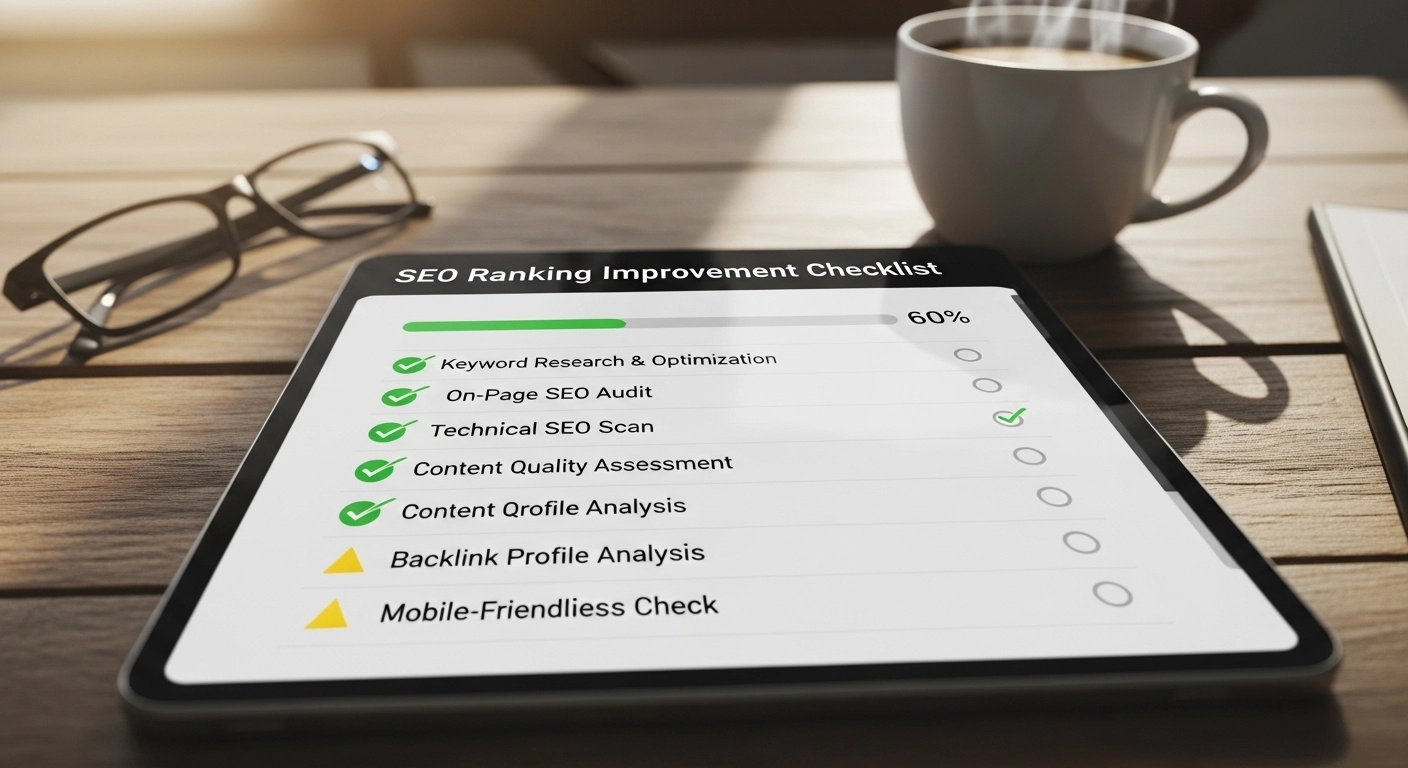
If your website isn’t ranking well on Google, the problem usually isn’t just one thing. SEO success comes from optimizing content, technical performance, user experience, and authority signals together.
This SEO ranking improvement checklist will help you identify what’s holding your site back and show you exactly what to fix. Whether you run a blog, business website, or online store, these proven steps can help increase visibility and drive more organic traffic.
1. Perform a Complete SEO Audit
Before improving rankings, you must understand your current SEO health.
An SEO audit helps identify issues like broken links, slow pages, missing metadata, and weak content.
Key things to check include:
- Crawl errors and indexing issues
- Duplicate content
- Broken links
- Missing title tags or meta descriptions
- Mobile usability problems
Tools like Google Search Console, Screaming Frog, and Ahrefs can quickly reveal these problems.
Example:
If Google cannot crawl your pages properly, even the best content will never rank.
2. Improve Keyword Targeting
Many websites struggle because they target the wrong keywords.
Instead of focusing only on competitive terms, target long-tail keywords and search intent.
For example:
Poor keyword target:
“SEO”
Better keyword target:
“SEO ranking improvement checklist”
Steps to improve keyword targeting:
- Research keywords with tools like SEMrush or Ubersuggest
- Focus on search intent (informational, commercial, transactional)
- Include related semantic keywords naturally in content
- Avoid keyword stuffing
When keywords match user intent, Google is far more likely to rank the page.
3. Optimize Title Tags and Meta Descriptions
Your title tag is one of the strongest on-page SEO signals.
Best practices:
Title Tag Checklist
- Include the main keyword
- Keep length between 50–60 characters
- Make it compelling for clicks
Example:
Bad title:
“SEO Tips”
Better title:
“SEO Ranking Improvement Checklist: 15 Ways to Boost Google Rankings”
Meta description tips:
- Keep around 150–160 characters
- Summarize the content clearly
- Add a call-to-action
A strong title and meta description can significantly improve click-through rate (CTR).
4. Fix On-Page SEO Structure
Every page should follow a clear content structure.
Use headings properly:
H1 – Page title
H2 – Main sections
H3 – Supporting topics
Example structure:
H1: SEO Ranking Improvement Checklist
H2: Improve Keyword Research
H2: Optimize On-Page SEO
H2: Build Quality Backlinks
This helps both users and search engines understand the page content.
Also optimize:
- URL structure
- Image alt text
- Internal linking
- Keyword placement in headings
5. Improve Content Quality
Google prioritizes helpful, authoritative, and comprehensive content.
Ask yourself:
- Does the content fully answer the search query?
- Is it better than the top ranking pages?
- Does it include examples, steps, or data?
Ways to improve content:
- Add actionable advice
- Use clear examples
- Update outdated information
- Expand thin articles
For example, a 300-word article rarely outranks a detailed 1500-word guide that solves the reader’s problem.
6. Strengthen Internal Linking
Internal links help Google discover pages and understand your website structure.
Benefits include:
- Passing SEO authority between pages
- Helping users navigate the site
- Increasing time on site
Example:
If you write about keyword research, link to related articles like:
- On-page SEO guide
- Content optimization tips
- SEO tools review
A good rule is to include 3–5 relevant internal links per article.
7. Improve Page Speed
Slow websites lose both rankings and visitors.
Google uses Core Web Vitals as a ranking factor.
Ways to improve speed:
- Compress images
- Use faster hosting
- Enable caching
- Minify CSS and JavaScript
- Use a content delivery network (CDN)
You can test your site using Google PageSpeed Insights.
A fast website improves both SEO rankings and user experience.
8. Make Your Website Mobile-Friendly
Google uses mobile-first indexing, meaning it primarily evaluates the mobile version of your site.
Ensure that:
- The layout is responsive
- Text is easy to read on mobile devices
- Buttons are clickable
- Images scale correctly
If your site is difficult to use on a phone, rankings will suffer.
9. Build High-Quality Backlinks
Backlinks remain one of the strongest ranking factors.
However, quality matters far more than quantity.
Focus on:
- Guest blogging on relevant websites
- Getting mentions from industry blogs
- Creating link-worthy content like guides or research
- Digital PR and outreach
Example:
A single backlink from a trusted site can be more powerful than dozens of low-quality links.
10. Update and Refresh Old Content
Updating existing content is one of the fastest ways to improve rankings.
Steps to refresh content:
- Add new information
- Improve readability
- Update statistics and examples
- Optimize keywords
- Add internal links
Google prefers fresh and relevant information, especially for competitive topics.
11. Improve User Experience (UX)
Google increasingly measures how users interact with your site.
Important UX factors include:
- Low bounce rate
- Longer time on page
- Easy navigation
- Clear formatting
Improve readability by:
- Using short paragraphs
- Adding headings and lists
- Including images or examples
When users stay longer, Google sees the page as valuable.
SEO Ranking Improvement Quick Checklist
Here is a quick summary checklist you can follow:
- Perform a full SEO audit
- Target the right keywords
- Optimize title tags and meta descriptions
- Improve content quality
- Fix heading structure
- Add internal links
- Improve page speed
- Make the site mobile friendly
- Build quality backlinks
- Update old content regularly
- Improve user experience
Following these steps consistently can significantly increase organic rankings.
Frequently Asked Questions
How long does SEO take to improve rankings?
Most websites start seeing improvements within 3 to 6 months, depending on competition, content quality, and backlink strength.
What is the most important SEO ranking factor?
There isn’t a single factor. The most important elements are high-quality content, relevant keywords, strong backlinks, and technical SEO performance.
How often should I update SEO content?
Updating content every 6–12 months helps keep it relevant and competitive in search results.
Can SEO work without backlinks?
Yes, especially for low-competition keywords. However, backlinks greatly increase ranking potential, especially in competitive niches.
Conclusion
Improving search rankings isn’t about shortcuts—it’s about consistent optimization across content, technical SEO, and authority signals.
By following this SEO ranking improvement checklist, you can systematically identify weaknesses, fix SEO problems, and build a stronger website that performs better in Google search.
The key is consistency. Small improvements across multiple areas often lead to major ranking gains over time.
