
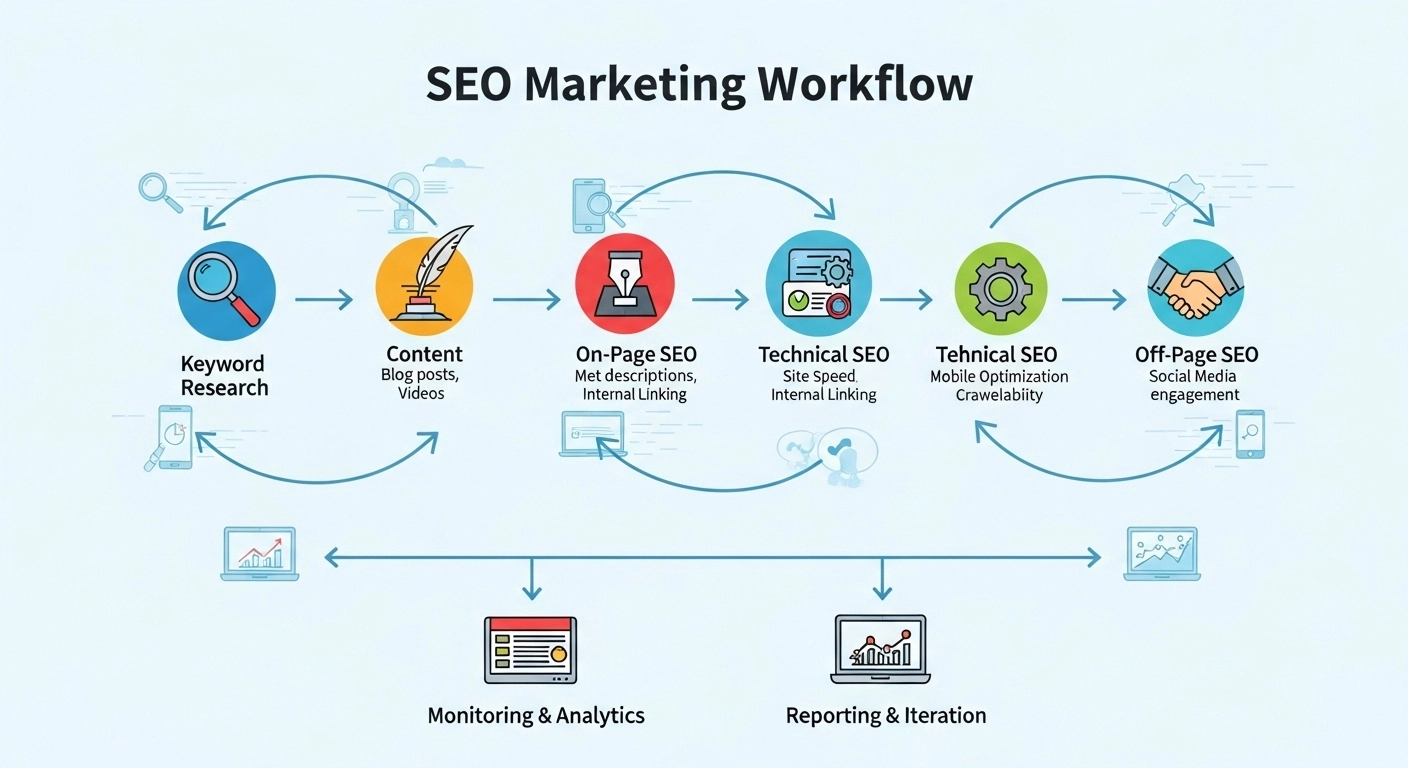
SEO success rarely happens by accident. Behind every high-ranking website is a clear, repeatable SEO marketing workflow—a structured process that turns ideas into optimized content that ranks in search engines and attracts the right audience.
Without a workflow, SEO becomes random: keywords are chosen poorly, content lacks direction, and results take longer. With a workflow, every step—from research to optimization—works together to build consistent search visibility.
This guide explains a practical SEO marketing workflow you can use to plan, create, publish, and improve content that ranks.
What Is an SEO Marketing Workflow?
An SEO marketing workflow is a step-by-step system used to plan and execute search engine optimization activities. It connects research, content creation, technical optimization, and performance tracking into a repeatable process.
Instead of guessing what to do next, the workflow ensures each task happens in the right order.
A typical SEO workflow includes:
Research → Planning → Content Creation → On-Page Optimization → Publishing → Promotion → Tracking → Improvement
When done consistently, this process builds long-term organic traffic and stronger search rankings.
Why an SEO Workflow Matters
Many websites fail to rank because they skip critical steps like keyword research or search intent analysis.
A structured workflow helps you:
• Target the right keywords
• Create content that matches user intent
• Improve site structure and internal linking
• Track what works and what needs improvement
• Scale SEO across many pages or blog posts
In short, it turns SEO from guessing into a repeatable growth strategy.
Step 1: Keyword Research and Search Intent
Every SEO workflow begins with understanding what people search for.
Start by identifying keywords your audience uses. But don’t stop at keywords—analyze search intent, which explains why someone is searching.
There are four main types of search intent:
Informational:
“what is SEO marketing”
Navigational:
“Ahrefs login”
Commercial:
“best SEO tools”
Transactional:
“buy SEO software”
Example:
If your keyword is SEO marketing workflow, users likely want a step-by-step guide, not a product page.
Helpful keyword research tasks:
• Find primary keyword
• Identify long-tail variations
• Analyze competitors
• Check search volume and difficulty
• Group related keywords into topic clusters
This step builds the foundation for the rest of the workflow.
Step 2: Create an SEO Content Brief
Before writing, create a content brief that guides the article.
A strong SEO brief usually includes:
Primary keyword
Secondary keywords
Search intent
Article structure
Competitor analysis
Internal linking opportunities
Example structure for a workflow article:
H1: SEO Marketing Workflow
H2: What Is It
H2: Why It Matters
H2: Steps
H2: Tools
H2: FAQ
This step ensures writers produce content aligned with SEO goals.
Step 3: Write High-Quality SEO Content
Once the brief is ready, it’s time to create content that answers the user’s question clearly and completely.
Good SEO content should be:
Easy to read
Well structured with headings
Helpful and informative
Focused on solving the user’s problem
Instead of repeating the same keyword, naturally include related terms like:
SEO process
content optimization
keyword strategy
search ranking
organic traffic
Example:
Instead of writing:
“SEO marketing workflow is important for SEO marketing workflow success.”
Write:
“A clear SEO workflow helps teams move from keyword research to content optimization without missing important steps.”
The goal is clarity and usefulness, not keyword repetition.
Step 4: Optimize On-Page SEO Elements
Once content is written, optimize the page for search engines.
Important on-page elements include:
Title Tag
Example:
SEO Marketing Workflow: The Complete Step-by-Step Guide
Meta Description
A short summary that encourages clicks from search results.
Example:
Learn the complete SEO marketing workflow—from keyword research to content optimization and tracking—to grow organic traffic faster.
Header Tags
Use clear H2 and H3 headings to structure the article.
Internal Links
Link to related content on your site to build topical authority.
Images and Alt Text
Use relevant visuals and describe them with alt text.
These signals help search engines understand your page.
Step 5: Publish and Ensure Technical SEO
Before publishing, confirm the page works properly.
Key technical checks include:
• Fast page loading speed
• Mobile-friendly design
• Proper URL structure
• HTTPS security
• Schema markup (optional but helpful)
Example URL:
example.com/seo-marketing-workflow
Simple, descriptive URLs improve crawlability and usability.
Step 6: Promote Your Content
Publishing alone is rarely enough.
Promote the content so search engines and users discover it faster.
Common promotion methods include:
• Social media sharing
• Email newsletters
• Internal linking from older articles
• Outreach to relevant websites
• Content repurposing (LinkedIn posts, short videos)
Promotion can generate early traffic and backlinks.
Step 7: Track SEO Performance
SEO requires measurement.
Track your page’s performance using analytics and search tools.
Key metrics to monitor:
Organic traffic
Keyword rankings
Click-through rate (CTR)
Bounce rate
Conversions
Example:
If your article ranks on page two, improving internal links or updating content could move it to page one.
Step 8: Update and Improve Content
SEO is never “done.”
Search engines reward fresh and updated content.
Regularly review your pages to:
Add new information
Improve examples
Update statistics
Expand sections
Improve internal linking
Example:
If a new SEO update changes ranking factors, updating your article keeps it relevant.
Content refreshes often lead to ranking improvements.
Example of a Simple SEO Marketing Workflow
Here is a simplified version many teams follow:
- Keyword research
- Analyze search intent
- Create content brief
- Write SEO-optimized content
- Optimize on-page elements
- Publish and index page
- Promote content
- Track rankings and traffic
- Update and improve regularly
This workflow ensures every piece of content has a clear purpose and optimization strategy.
Tools That Help Manage an SEO Workflow
While workflows can be done manually, tools make the process easier.
Popular SEO tools help with:
Keyword research
Content optimization
Technical SEO analysis
Rank tracking
Competitor research
Examples include:
Google Search Console
Google Analytics
Ahrefs
SEMrush
Screaming Frog
Using the right tools speeds up the workflow and improves decision-making.
FAQ: SEO Marketing Workflow
What is the main goal of an SEO workflow?
The goal is to create a repeatable system that helps websites research keywords, create optimized content, and improve search rankings consistently.
How long does SEO take to show results?
Most SEO efforts take 3 to 6 months to show meaningful improvements, depending on competition and website authority.
Can small websites use an SEO workflow?
Yes. In fact, smaller websites benefit the most because a structured process helps them compete with larger sites.
How often should SEO content be updated?
Updating important articles every 6–12 months helps maintain rankings and improve performance.
Is SEO only about keywords?
No. Modern SEO also includes user experience, technical performance, search intent, content quality, and backlinks.
Conclusion
An effective SEO marketing workflow turns search optimization into a clear, repeatable process instead of guesswork.
By following a structured path—from keyword research and content creation to optimization and performance tracking—you can consistently publish content that ranks and attracts organic traffic.
The key is consistency. When every article follows the same workflow, your website gradually builds authority, improves rankings, and attracts the right audience.
