
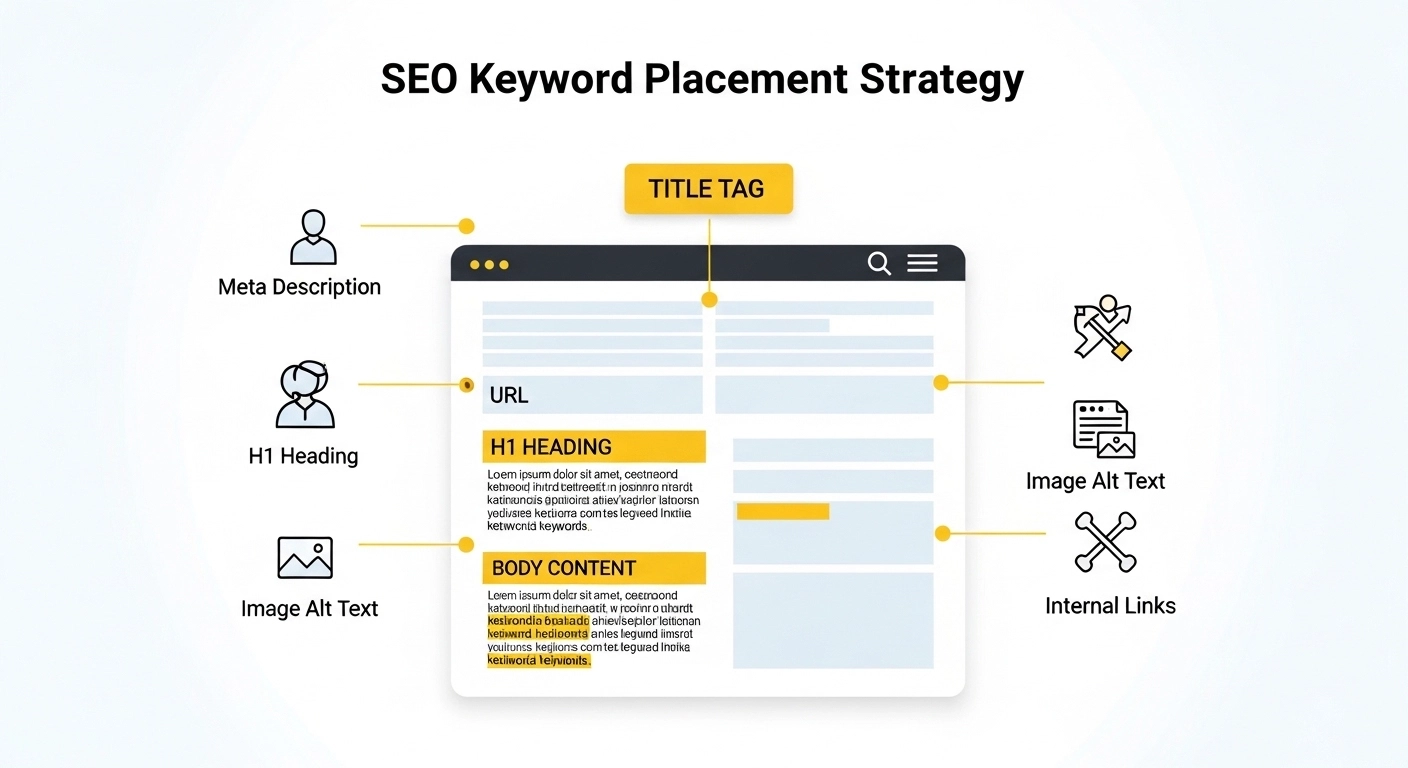
Search engines have become smarter, but where you place your keywords still matters. A well-planned SEO keyword placement strategy helps search engines understand your content and improves your chances of ranking higher in Google.
However, effective keyword placement is not about stuffing the same phrase everywhere. It’s about placing keywords naturally in the right locations so both users and search engines can clearly understand your topic.
This guide explains exactly where to place keywords in your content, how often to use them, and how to do it without hurting readability.
What Is an SEO Keyword Placement Strategy?
An SEO keyword placement strategy is the process of placing your target keyword and related terms in important parts of your webpage so search engines can easily identify the page’s topic.
These locations typically include:
- Page title
- Headings (H1, H2, H3)
- URL
- Meta description
- Introduction paragraph
- Image alt text
- Internal links
- Content body
When keywords appear in these key areas naturally and logically, search engines are more likely to rank the page for relevant searches.
Why Keyword Placement Matters for SEO
Search engines scan webpages to understand their topic and relevance. Strategic keyword placement helps them do that faster and more accurately.
Here are the main benefits:
Improves search engine understanding
Clear keyword placement tells Google what the page is about.
Boosts ranking potential
Properly optimized pages have a higher chance of ranking for target keywords.
Enhances user experience
Well-structured content makes it easier for readers to scan and understand.
Supports semantic SEO
Using related keywords helps search engines understand the full context of your topic.
The Most Important Places to Put Keywords
1. Page Title (Title Tag)
Your title tag is one of the strongest ranking signals in on-page SEO.
Best practice:
- Place the main keyword near the beginning
- Keep it under 60 characters
- Make it compelling for clicks
Example:
Bad:
Guide to Digital Marketing and SEO Keyword Placement Strategy Tips
Better:
SEO Keyword Placement Strategy: The Complete Beginner Guide
2. URL Structure
Clean URLs help both users and search engines understand the page topic.
Example:
Bad URL
example.com/post123?id=seo
Better URL
example.com/seo-keyword-placement-strategy
Keep URLs short and descriptive.
3. H1 Heading
Your H1 is the main headline of the page and should include the primary keyword.
Example:
H1:
SEO Keyword Placement Strategy for Higher Rankings
Use only one H1 per page.
4. Introduction Paragraph
Search engines pay attention to the first 100 words.
Try to include your main keyword naturally in the introduction.
Example:
“An effective SEO keyword placement strategy ensures your content is easy for search engines to understand while remaining helpful for readers.”
5. Subheadings (H2 and H3)
Use related keywords and variations in your headings.
Examples:
H2: Where to Place Keywords in Blog Posts
H2: Common Keyword Placement Mistakes
H3: Using Keywords in Image Alt Text
This improves content structure and topical relevance.
6. Content Body
Your keyword should appear naturally throughout the article, but avoid repeating it too often.
Tips:
- Use synonyms and variations
- Write for humans first
- Focus on answering the search intent
Example related terms:
- keyword optimization
- SEO keyword strategy
- keyword targeting
- search intent optimization
7. Image Alt Text
Search engines cannot see images, so alt text helps them understand what the image shows.
Example:
Alt text:
“SEO keyword placement strategy diagram for blog optimization”
8. Meta Description
While the meta description is not a direct ranking factor, it improves click-through rate (CTR).
Best practice:
- Include the keyword naturally
- Keep it under 160 characters
Example:
“Learn the best SEO keyword placement strategy to improve rankings, optimize blog posts, and attract more organic traffic.”
9. Internal Links
Linking to other pages on your website helps search engines discover content and understand site structure.
Example:
“If you are new to SEO, start with our on-page SEO checklist.”
Use descriptive anchor text when linking.
How Often Should You Use Keywords?
There is no perfect keyword density. Instead, focus on natural usage.
A simple rule:
- Use the keyword in key locations
- Add variations throughout the content
- Avoid forcing the phrase repeatedly
If the article reads naturally, the keyword usage is usually correct.
Common Keyword Placement Mistakes
Even experienced bloggers sometimes make these errors.
Keyword stuffing
Repeating the keyword too many times hurts readability and rankings.
Ignoring search intent
Using keywords without matching what users actually want.
Over-optimized anchor text
Using the exact keyword in every internal link.
Forgetting semantic keywords
Google understands related terms, so include them naturally.
Simple Keyword Placement Formula
A quick formula many SEO writers follow:
Title + H1 + Introduction + Subheadings + Content + Images + Internal Links
When these elements include your keyword naturally, your page becomes easier for search engines to understand.
FAQ: SEO Keyword Placement Strategy
Where should keywords appear for SEO?
Keywords should appear in the title tag, H1 heading, introduction, subheadings, body content, image alt text, and URL. These areas help search engines determine the page topic.
How many times should I use a keyword?
There is no exact number. Focus on natural usage and relevance rather than a specific keyword density.
Should I use exact keywords or variations?
Use both. Exact keywords help target the search query, while variations and related terms improve semantic SEO.
Does keyword placement still matter in modern SEO?
Yes. While Google is more advanced today, proper keyword placement still helps search engines understand content structure and relevance.
Final Thoughts
A strong SEO keyword placement strategy is not about repeating the same phrase everywhere. It’s about placing keywords strategically and naturally so search engines and readers both understand your content.
Focus on:
- Clear titles
- Structured headings
- Natural keyword usage
- Helpful, high-quality content
When done correctly, keyword placement becomes a powerful foundation for higher rankings and more organic traffic.
Ready to Improve Your SEO?
Start by reviewing your existing content and optimizing:
- Titles
- Headings
- URLs
- Internal links
Small improvements in keyword placement can make a big difference in search visibility and traffic.
