
A well-organized website is one of the most powerful SEO advantages you can have. Even great content can struggle to rank if your site structure is confusing for users and search engines.
SEO site structure optimization means organizing your website so visitors can easily find information and search engines can efficiently crawl and understand your pages.
In this guide, you’ll learn how to structure your site the right way, improve search visibility, and create a better user experience.
What Is SEO Site Structure Optimization?
SEO site structure optimization is the process of organizing pages, links, and content in a clear hierarchy so both users and search engines can navigate your website easily.
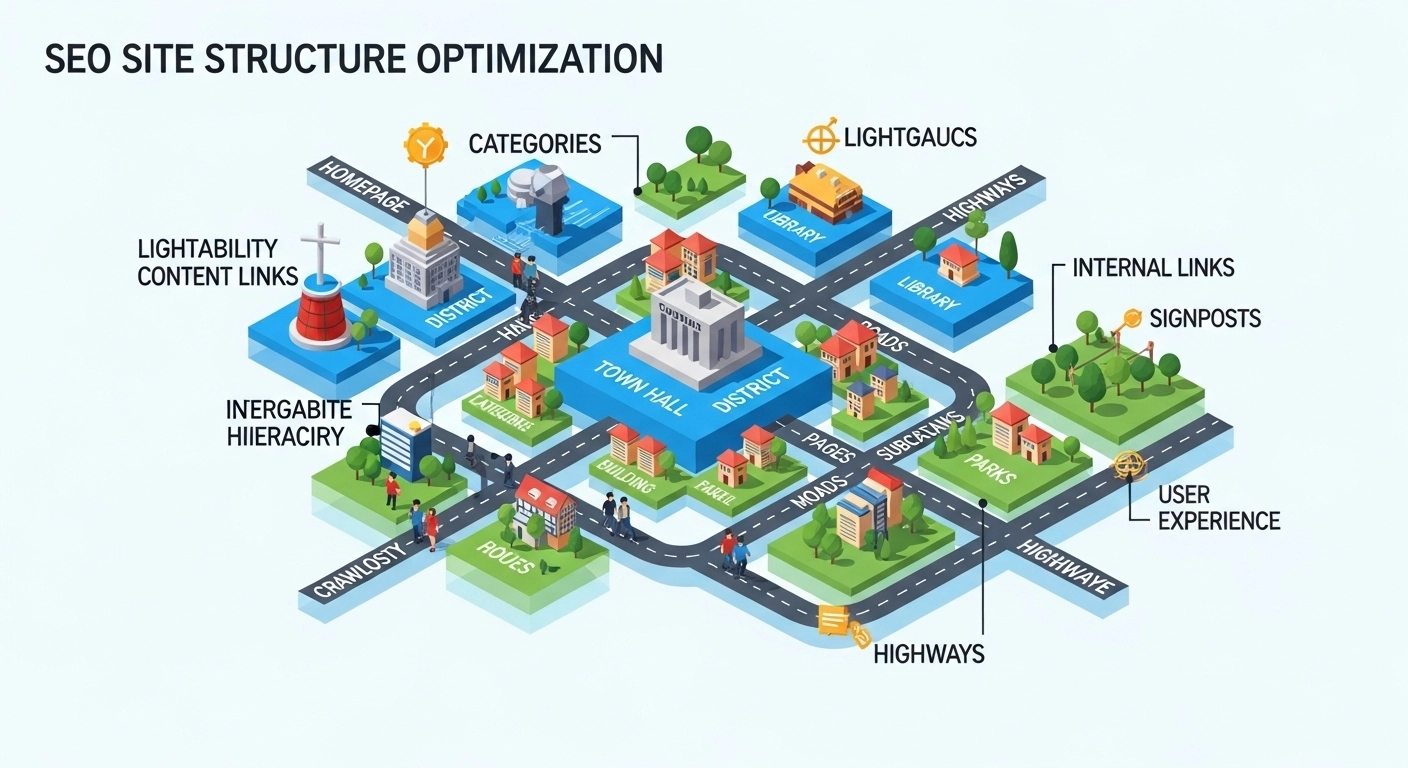
Think of your website like a library:
- The homepage is the main entrance
- Categories are the sections
- Subpages are the books
If everything is organized logically, visitors find what they need quickly—and search engines understand your website better.
A strong structure improves:
- Crawlability
- Indexing
- Internal linking
- User experience
- Rankings
Why Site Structure Matters for SEO
Search engines use links to discover and understand pages. A messy structure makes it harder for them to crawl your site.
A clear structure helps Google:
- Discover pages faster
- Understand topic relationships
- Pass link authority between pages
- Rank content more accurately
For users, it means less confusion and faster navigation.
Good structure also reduces bounce rate and improves engagement.
The Ideal Website Structure (Simple Hierarchy)
A clean website hierarchy looks like this:
Homepage
→ Category
→ Subcategory
→ Individual Page
Example:
Homepage
→ SEO Guides
→ On-Page SEO
→ SEO Site Structure Optimization
This structure keeps everything organized and easy to navigate.
A good rule: every page should be reachable within 3 clicks from the homepage.
Use Topic Clusters and Pillar Pages
Modern SEO works best with a pillar and cluster structure.
A pillar page covers a broad topic.
Cluster pages focus on related subtopics.
Example:
Pillar Page:
Complete Guide to SEO
Cluster Pages:
- On-Page SEO Guide
- Technical SEO Basics
- Keyword Research Guide
- SEO Site Structure Optimization
All cluster pages link back to the pillar page.
This creates topical authority, which helps search engines understand your expertise.
Build a Strong Internal Linking Strategy
Internal links connect pages across your website. They are critical for SEO.
Benefits include:
- Helping Google discover pages
- Passing ranking power between pages
- Improving user navigation
Example:
If you write about SEO content writing, you can link to your article about site structure optimization.
Best practices:
- Use descriptive anchor text
- Link to relevant pages
- Avoid excessive linking
- Update old posts with new internal links
Smart internal linking builds a strong SEO network inside your website.
Create Clear URL Structures
Clean URLs help both users and search engines understand your page topic.
Good example:
yourwebsite.com/seo/site-structure-optimization
Bad example:
yourwebsite.com/page?id=4739
Best practices:
- Keep URLs short
- Use keywords naturally
- Avoid unnecessary numbers or symbols
- Separate words with hyphens
Simple URLs improve readability and ranking potential.
Optimize Your Navigation Menu
Your navigation menu is the roadmap of your website.
It should guide visitors to your most important pages.
Best practices:
- Limit menu items to essential pages
- Use clear labels (Blog, Services, Guides)
- Avoid deep nested menus
- Highlight main categories
A well-designed navigation menu improves both SEO and user experience.
Use Breadcrumbs for Better Navigation
Breadcrumbs show users where they are on your website.
Example:
Home → SEO → Technical SEO → Site Structure Optimization
Benefits:
- Improves user navigation
- Reduces bounce rate
- Helps search engines understand page hierarchy
- Enhances search result appearance
Many websites use breadcrumbs to create a clearer site structure.
Improve Crawlability with XML Sitemaps
An XML sitemap tells search engines which pages exist on your website.
It helps search engines crawl your site more efficiently.
Most CMS platforms automatically generate sitemaps.
After creating one, submit it through Google Search Console.
This ensures search engines discover and index your content faster.
Avoid Common Site Structure Mistakes
Many websites struggle with SEO because of poor structure.
Common mistakes include:
Too many categories
Orphan pages with no internal links
Confusing navigation
Duplicate content
Very deep page levels
Fixing these issues can significantly improve SEO performance.
Practical Example of an Optimized Site Structure
Imagine a website about digital marketing.
Homepage
→ SEO
→ On-Page SEO
→ Technical SEO
→ Link Building
Homepage
→ Content Marketing
→ Blogging Tips
→ Copywriting
This structure groups related topics together and makes navigation simple.
Search engines can easily understand the website’s main themes.
SEO Site Structure Optimization Checklist
Use this quick checklist when optimizing your website:
Clear site hierarchy
Logical categories
Strong internal linking
Short keyword-friendly URLs
Optimized navigation menu
Breadcrumb navigation
XML sitemap submitted to Google
No orphan pages
Following these steps creates a search-engine-friendly website architecture.
FAQ: SEO Site Structure Optimization
What is the best site structure for SEO?
The best structure is a simple hierarchical structure where pages are organized into clear categories and subcategories. This helps search engines crawl and understand your website efficiently.
How many clicks should a page be from the homepage?
Ideally, important pages should be within three clicks from the homepage. This improves crawlability and user experience.
Does site structure affect rankings?
Yes. A well-optimized site structure improves crawlability, internal linking, and topical relevance—all of which influence rankings.
What are orphan pages in SEO?
Orphan pages are pages that have no internal links pointing to them. Search engines may struggle to find and index them.
Should URLs include keywords?
Yes. Including relevant keywords in URLs helps search engines understand the page topic and can improve SEO.
Final Thoughts
SEO site structure optimization is the foundation of a high-performing website. Without a clear structure, even great content can struggle to rank.
By organizing your website with a logical hierarchy, using internal links strategically, and creating clean URLs, you make it easier for both users and search engines to navigate your content.
A well-structured site not only improves rankings—it also builds trust and delivers a better experience for your visitors.
Start optimizing your site structure today, and you’ll build a stronger SEO foundation for long-term growth.
