
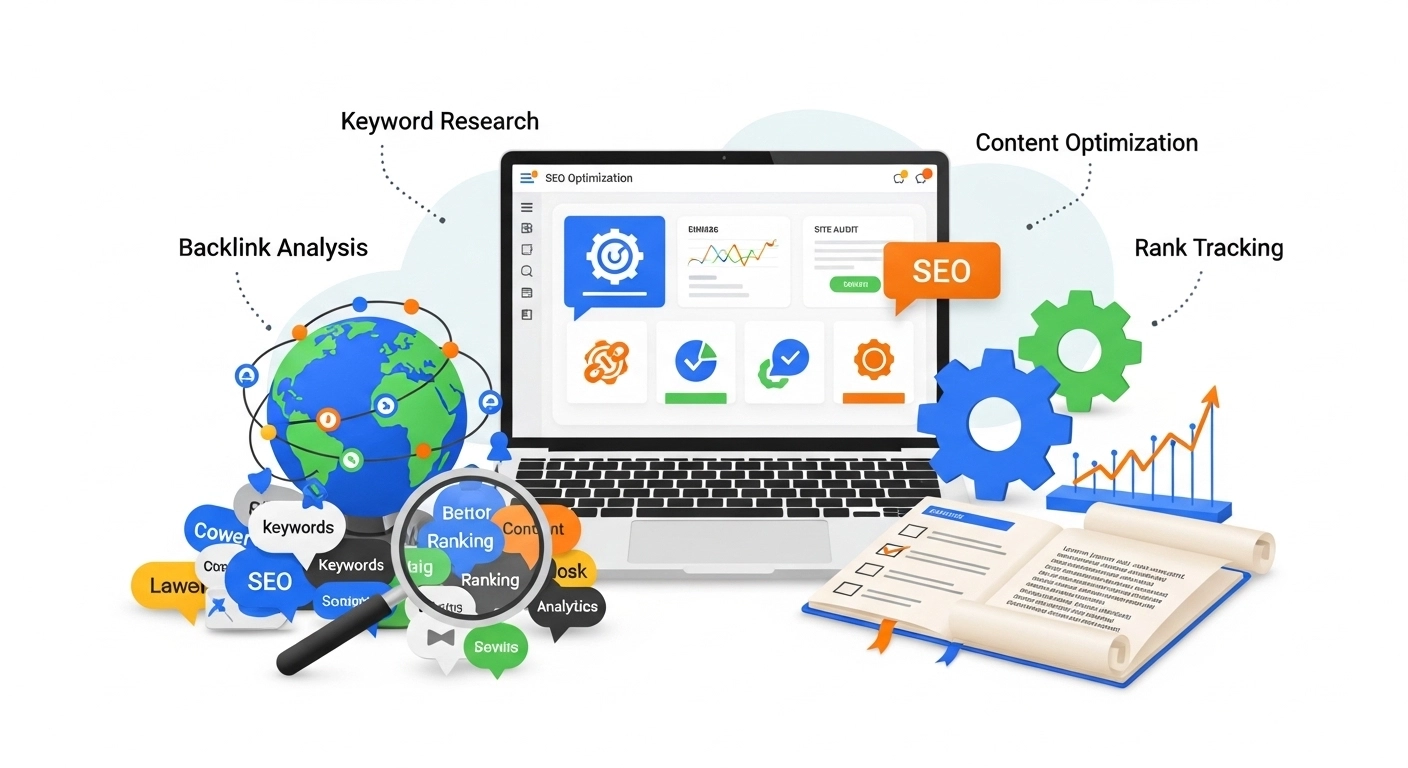
Search engine optimization has become more competitive than ever. Ranking on Google today requires more than just good content—you also need the right SEO tools to research keywords, analyze competitors, audit your site, and track performance.
The good news? You don’t need dozens of tools. A smart combination of reliable SEO optimization tools can help you improve rankings, drive traffic, and grow your website faster.
In this guide, you’ll find a practical SEO optimization tools list, including tools for keyword research, technical SEO, on-page optimization, and performance tracking.
Why SEO Tools Matter
SEO involves many moving parts: keywords, site speed, backlinks, indexing, content quality, and technical structure. Doing all of this manually would take days.
SEO tools help you:
- Discover keywords people actually search
- Analyze competitor strategies
- Fix technical SEO problems
- Improve on-page optimization
- Track rankings and traffic growth
In short, the right tools make SEO faster, smarter, and more accurate.
Best SEO Optimization Tools List
Below are some of the most trusted SEO tools used by bloggers, agencies, and digital marketers.
1. Google Search Console
Google Search Console is one of the most essential SEO tools—and it’s completely free.
It helps you understand how Google sees your website and shows which keywords bring visitors to your site.
Key features
- Monitor search performance
- Submit sitemaps
- Fix indexing issues
- Track clicks, impressions, and rankings
- Detect technical errors
Example:
If a page is not appearing in Google search results, Search Console will show whether the page is indexed or blocked.
2. Google Analytics
Google Analytics tracks what visitors do on your website.
While Search Console focuses on search traffic, Analytics shows user behavior after they arrive.
Key insights you get
- Traffic sources
- User behavior
- Most visited pages
- Bounce rate
- Conversion tracking
This data helps you improve your content and understand what actually works.
3. Ahrefs
Ahrefs is one of the most powerful all-in-one SEO platforms available today.
It is widely used for backlink analysis, competitor research, and keyword discovery.
Top features
- Keyword explorer
- Backlink checker
- Site audit tool
- Content gap analysis
- Rank tracking
Example:
You can enter a competitor’s website and instantly see the keywords they rank for.
4. SEMrush
SEMrush is another comprehensive SEO and digital marketing platform.
It provides tools for SEO, PPC, content marketing, and competitive research.
Best features
- Keyword research tools
- Domain analysis
- SEO site audits
- Position tracking
- Content optimization tools
Many SEO professionals use SEMrush to build complete marketing strategies.
5. Ubersuggest
Ubersuggest is a beginner-friendly SEO tool created by digital marketer Neil Patel.
It’s great for bloggers and small businesses who want simple keyword and SEO insights.
Features include
- Keyword suggestions
- SEO difficulty scores
- Content ideas
- Domain analysis
- Backlink data
It’s especially useful if you’re just starting with SEO.
6. Yoast SEO (WordPress)
Yoast SEO is one of the most popular WordPress plugins for on-page SEO.
It helps optimize blog posts and pages directly inside the WordPress editor.
Main benefits
- SEO readability analysis
- Keyword optimization guidance
- Meta title and description editing
- XML sitemap generation
- Schema support
This tool makes on-page SEO much easier for beginners.
7. Rank Math
Rank Math is another powerful WordPress SEO plugin that many website owners now prefer.
It offers more built-in features compared to many other plugins.
Key features
- On-page SEO analysis
- Keyword optimization
- Schema markup
- Google Search Console integration
- Advanced sitemap settings
Rank Math is especially useful for improving technical and on-page SEO.
8. Screaming Frog SEO Spider
Screaming Frog is a technical SEO crawler used to analyze websites.
It scans your website the same way search engines do and identifies problems.
What it detects
- Broken links
- Missing meta tags
- Duplicate content
- Redirect issues
- Site structure problems
This tool is commonly used by SEO agencies for technical audits.
9. Moz Pro
Moz Pro is a well-known SEO software suite designed for keyword research, link building, and rank tracking.
Popular features
- Keyword explorer
- Link research
- Domain authority analysis
- Site crawl tools
- Rank tracking
Moz is known for its easy interface and reliable SEO metrics.
10. PageSpeed Insights
Page speed is a major ranking factor. Google’s PageSpeed Insights tool analyzes your website performance.
What it measures
- Page loading speed
- Core Web Vitals
- Mobile performance
- Optimization suggestions
Improving page speed often leads to better rankings and user experience.
How to Choose the Right SEO Tools
Not every website needs every SEO tool. The best approach is to combine tools based on your needs.
Simple SEO tool stack example
- Keyword research: Ahrefs or Ubersuggest
- Technical SEO: Screaming Frog
- Analytics: Google Analytics
- Search monitoring: Google Search Console
- On-page optimization: Yoast SEO or Rank Math
This combination covers almost every important part of SEO.
FAQ: SEO Optimization Tools
What are SEO optimization tools?
SEO optimization tools are software programs that help analyze, improve, and monitor website performance in search engines.
They assist with keyword research, technical audits, backlink analysis, and ranking tracking.
Are free SEO tools good enough?
Yes, many free SEO tools are extremely powerful. For example:
- Google Search Console
- Google Analytics
- PageSpeed Insights
However, paid tools like Ahrefs or SEMrush provide deeper insights.
Which SEO tool is best for beginners?
Ubersuggest, Google Search Console, and Yoast SEO are excellent choices for beginners because they are simple and easy to use.
Do SEO tools guarantee rankings?
No tool can guarantee rankings. SEO tools only provide data and insights. Your rankings depend on content quality, backlinks, technical SEO, and competition.
Conclusion
SEO success depends on using the right strategy—and the right tools. The tools listed above help you research keywords, analyze competitors, fix technical problems, and improve content performance.
If you’re serious about growing your website traffic, start with a simple SEO toolkit like Google Search Console, Google Analytics, and a keyword research tool. As your site grows, you can add advanced tools like Ahrefs or SEMrush.
The key is not using more tools—but using the right ones consistently.
