
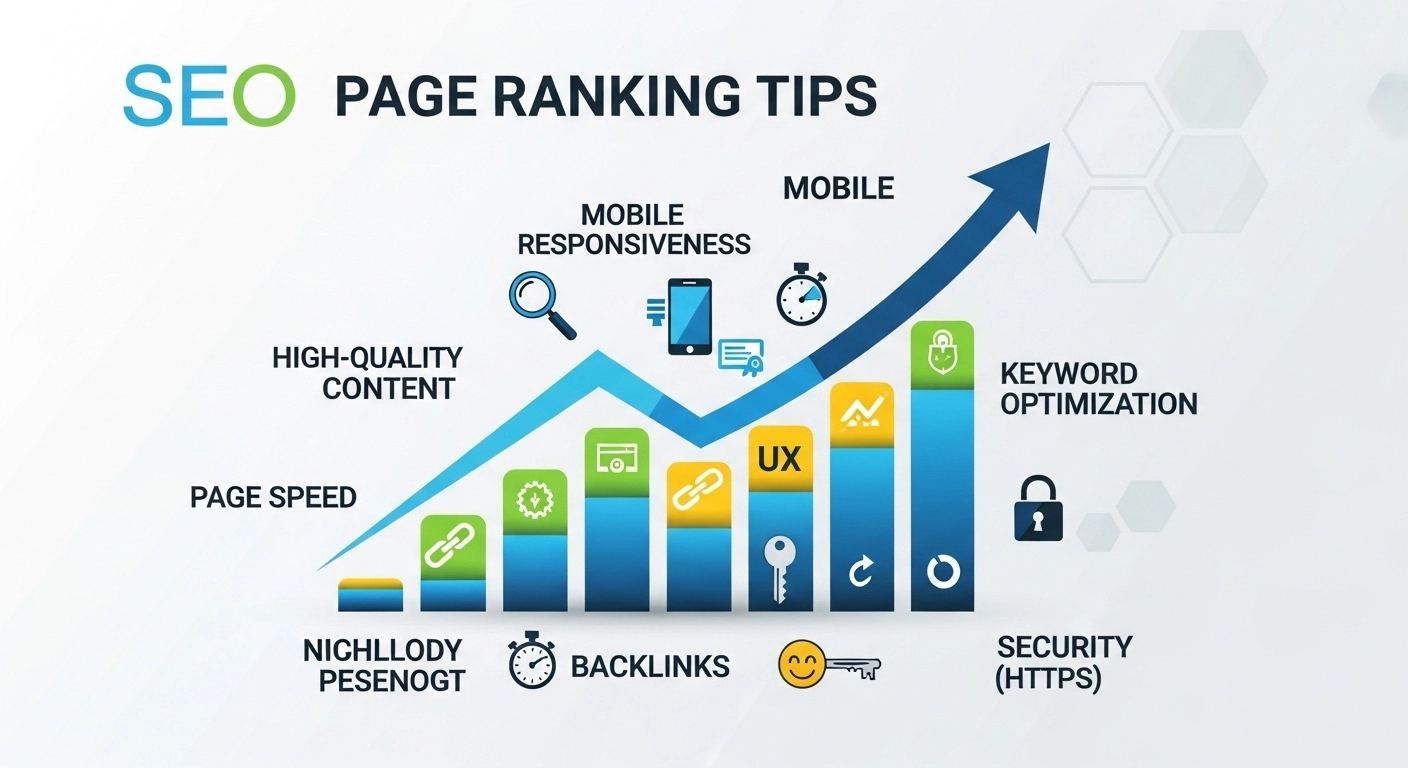
Getting your pages to rank higher on Google isn’t about tricks or shortcuts. It’s about creating helpful content, optimizing your website correctly, and giving users a great experience. When done right, SEO can bring consistent organic traffic to your website for months or even years.
If you want your pages to appear on the first page of search results, the following SEO page ranking tips will help you build a strong foundation and improve your visibility.
Understand Search Intent First
Before writing any content, ask yourself a simple question: What is the user actually searching for?
Search intent means the reason behind a search query. Google’s goal is to show the most relevant result that solves the user’s problem.
There are four main types of search intent:
- Informational – The user wants to learn something
- Navigational – The user wants a specific website
- Transactional – The user wants to buy something
- Commercial investigation – The user is comparing options
For example, if someone searches “SEO page ranking tips”, they want practical advice they can apply immediately. So your content should focus on clear, actionable strategies rather than theory.
Perform Smart Keyword Research
Keyword research helps you understand what people are searching for and how competitive those terms are.
Instead of focusing only on high-volume keywords, target long-tail keywords that are easier to rank for.
Example:
- “SEO tips” (very competitive)
- “SEO page ranking tips for beginners” (more specific and easier)
Useful keyword tools include:
- Google Keyword Planner
- Ahrefs
- SEMrush
- Ubersuggest
Also look at related searches and People Also Ask sections in Google to find additional keyword ideas.
Write High-Quality, Helpful Content
Content quality is one of the strongest ranking factors.
Google rewards pages that provide clear, helpful, and complete answers to a search query.
Good SEO content should:
- Answer the user’s question quickly
- Be easy to read and scan
- Include examples and explanations
- Provide unique insights
Instead of writing long blocks of text, break content into short paragraphs with headings, lists, and examples.
Example:
Instead of saying:
“SEO is important for websites.”
Write something more helpful:
“Businesses that invest in SEO often see higher organic traffic because their pages appear when people search for relevant topics.”
Helpful content keeps users on your page longer, which can improve rankings.
Optimize Your Title Tag and Meta Description
Your title tag is one of the most important on-page SEO elements. It tells both users and search engines what the page is about.
Best practices for titles:
- Keep it under 60 characters
- Include your main keyword
- Make it compelling to click
Example:
Bad title:
SEO Tips
Better title:
10 SEO Page Ranking Tips to Boost Your Google Traffic
Your meta description should briefly summarize the page and encourage clicks.
Example:
“Learn proven SEO page ranking tips to improve your Google rankings, increase organic traffic, and optimize your website for better search visibility.”
Use Proper Heading Structure
Headings make your content easier to read and help search engines understand the page structure.
A typical structure looks like this:
H1 – Main title
H2 – Main sections
H3 – Subsections
Example structure:
H1: SEO Page Ranking Tips
H2: Keyword Research
H2: Content Optimization
H2: Technical SEO
This structure helps both readers and search engines navigate your content.
Improve Page Speed
Page speed is a confirmed Google ranking factor.
If your site loads slowly, visitors leave quickly, increasing your bounce rate.
Ways to improve speed:
- Compress images
- Use fast hosting
- Enable caching
- Minimize unnecessary plugins
- Use a content delivery network (CDN)
Tools like Google PageSpeed Insights and GTmetrix can show exactly what needs improvement.
Build Strong Internal Links
Internal linking helps search engines understand your website structure and distributes authority across your pages.
For example, if you write a post about keyword research, link to other related articles such as:
- On-page SEO checklist
- SEO content writing tips
- Technical SEO guide
This improves crawlability and keeps users exploring your site longer.
Earn High-Quality Backlinks
Backlinks remain one of the strongest ranking signals in SEO.
A backlink is when another website links to your content. Google sees this as a vote of confidence.
Ways to earn backlinks:
- Write high-quality blog posts
- Create original research or guides
- Guest post on relevant websites
- Build relationships with bloggers in your industry
Focus on quality over quantity. A few links from trusted sites can be more valuable than hundreds from low-quality sites.
Optimize for Mobile Users
Most searches now happen on mobile devices, so Google uses mobile-first indexing.
Your website should:
- Be responsive on all devices
- Have readable text without zooming
- Load quickly on mobile networks
- Use clear navigation
You can test your website using Google’s Mobile-Friendly Test tool.
Update Content Regularly
Fresh content signals that your site is active and relevant.
Updating old posts can significantly improve rankings.
For example:
- Add new statistics
- Expand sections
- Improve formatting
- Update outdated information
Sometimes updating a post can push it from page two to page one in search results.
Focus on User Experience
Google increasingly measures user experience signals, including:
- Time on page
- Bounce rate
- Page speed
- Mobile usability
A good user experience means visitors find what they need quickly and easily.
Simple improvements include:
- Clear navigation
- Readable fonts
- Logical page structure
- Minimal pop-ups
When users enjoy your website, search engines notice.
Frequently Asked Questions
How long does it take for SEO rankings to improve?
SEO usually takes 3 to 6 months to show noticeable results. The timeline depends on competition, content quality, and backlink strength.
What is the most important SEO ranking factor?
There isn’t just one factor, but high-quality content and strong backlinks are two of the most influential.
Can I rank without backlinks?
Yes, especially for low-competition keywords. However, backlinks significantly improve your chances of ranking higher.
How often should I update SEO content?
Review important pages every 6 to 12 months and update them with fresh information, keywords, and improvements.
Conclusion
Ranking higher in search results doesn’t happen overnight, but the right SEO strategy can steadily improve your visibility and traffic.
Focus on understanding search intent, creating helpful content, optimizing on-page elements, improving site speed, and building quality backlinks. When these elements work together, your pages become much more likely to rank well.
SEO is a long-term investment, but the rewards—consistent traffic, better brand visibility, and more customers—make it worth the effort.
Start applying these SEO page ranking tips today, and your website will be in a much stronger position to climb the search results.
