
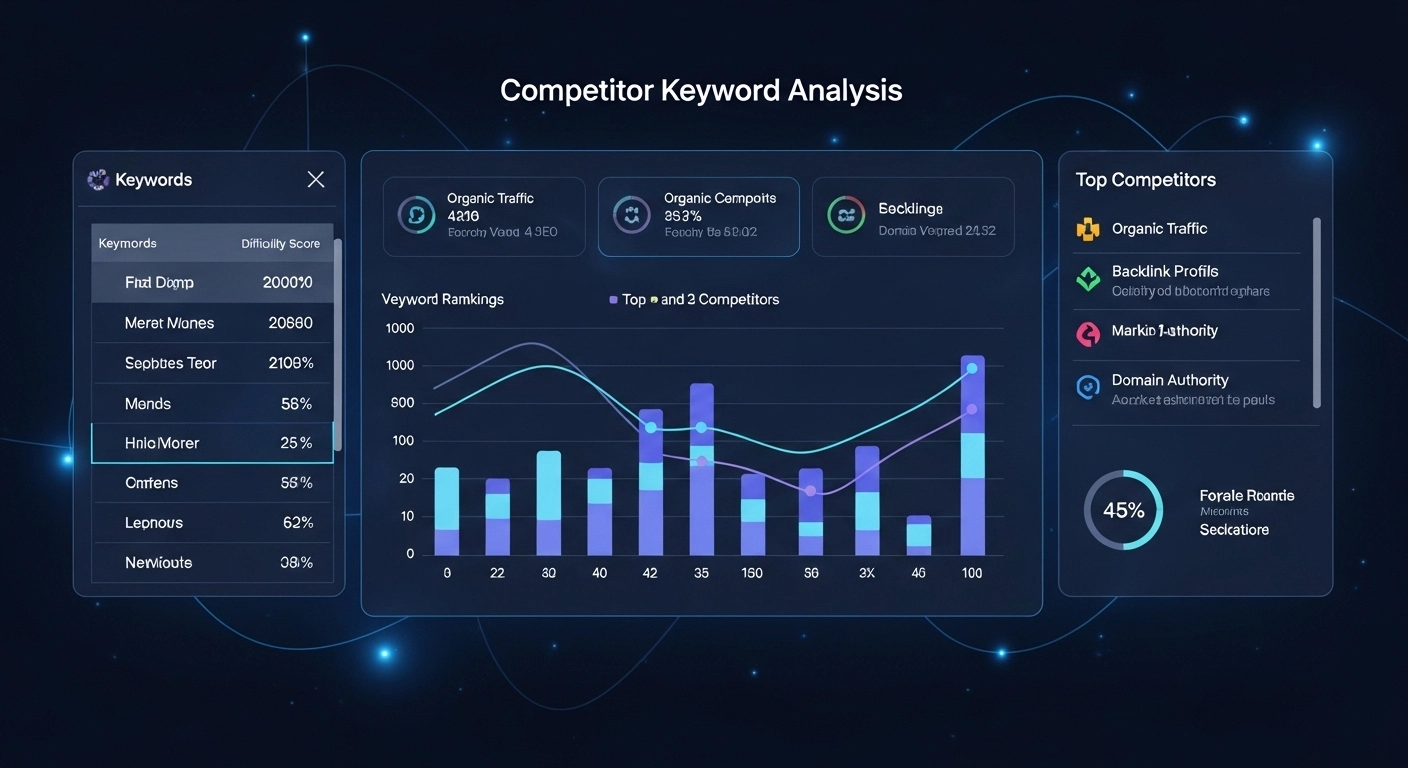
If you want to grow organic traffic faster, one of the smartest strategies is SEO competitor keyword analysis. Instead of guessing which keywords might work, you analyze what already works for your competitors and use that insight to build a stronger SEO strategy.
This approach helps you discover high-value keywords, content gaps, and ranking opportunities that can bring consistent traffic to your website.
In this guide, you’ll learn what competitor keyword analysis is, why it matters, and how to do it step-by-step.
What Is SEO Competitor Keyword Analysis?
SEO competitor keyword analysis is the process of identifying the keywords your competitors rank for in search engines and evaluating whether you can target those keywords on your own website.
By analyzing competitors, you can uncover:
- Keywords bringing them traffic
- Content topics that perform well
- Ranking opportunities you may be missing
- Weak spots in their SEO strategy
Instead of starting from zero, you learn directly from websites that are already ranking on Google.
Why Competitor Keyword Analysis Is Important
A strong SEO strategy is built on data. Competitor analysis gives you real insights instead of assumptions.
Here are the biggest benefits:
1. Discover High-Traffic Keywords
Your competitors may already rank for valuable keywords with high search volume. By identifying them, you can target similar terms and capture part of that traffic.
2. Find Content Gaps
Content gaps are keywords your competitors rank for but you don’t. Filling these gaps helps expand your website’s visibility.
3. Understand Search Intent
Looking at competitor pages helps you understand what type of content Google prefers for a keyword (guides, product pages, reviews, etc.).
4. Improve Your Content Strategy
Competitor analysis shows what works in your niche, making it easier to create content that ranks.
How to Do SEO Competitor Keyword Analysis (Step-by-Step)
1. Identify Your SEO Competitors
Your SEO competitors are websites ranking on Google for your target keywords, not necessarily your business competitors.
For example, if your site is about digital marketing, your competitors might include:
- Marketing blogs
- SEO agencies
- Industry publications
Search your main keywords on Google and note the websites that appear repeatedly.
2. Use SEO Tools to Find Their Keywords
Several SEO tools reveal which keywords competitors rank for:
- Ahrefs
- SEMrush
- Ubersuggest
- Moz
Enter a competitor’s domain into one of these tools and view their organic keyword rankings.
You’ll typically see data like:
- Keyword
- Search volume
- Keyword difficulty
- Current ranking position
- Traffic potential
Export or record the most relevant keywords.
3. Identify Keyword Gaps
A keyword gap is a keyword your competitors rank for but your site does not.
Most SEO tools offer a Keyword Gap Analysis feature that compares domains and highlights missing opportunities.
Look for:
- Medium competition keywords
- Long-tail keywords
- Keywords related to your niche topics
These are often the quickest wins for SEO growth.
4. Analyze the Competitor’s Content
Finding keywords is only half the process. Next, analyze why their content ranks.
Look at factors such as:
- Article length
- Structure and headings
- Internal links
- Use of images or examples
- Page speed and user experience
Then create better, more helpful content.
A simple rule:
Your content should be clearer, deeper, and more useful than the competitor’s page.
5. Prioritize the Best Keywords
Not every keyword is worth targeting.
Focus on keywords that have:
- Good search volume
- Manageable competition
- Clear search intent
- Relevance to your audience
A balanced keyword list usually includes:
- Long-tail keywords
- Informational keywords
- Transactional keywords
This mix helps drive both traffic and conversions.
Example of Competitor Keyword Analysis
Imagine you run a blog about SEO for beginners.
A competitor ranks for these keywords:
- “on page SEO checklist”
- “SEO keyword research guide”
- “technical SEO audit steps”
If your website does not have content on these topics, you’ve discovered three content opportunities.
You could publish articles like:
- The Complete On-Page SEO Checklist for 2026
- Step-by-Step Keyword Research Guide
- Technical SEO Audit: Beginner-Friendly Process
By targeting proven keywords, your chances of ranking increase significantly.
Common Mistakes to Avoid
Even experienced marketers sometimes make mistakes with competitor keyword analysis.
Avoid these common problems:
Targeting only high-volume keywords
These are usually the most competitive.
Copying competitor content exactly
Always create original, better content.
Ignoring search intent
A keyword might look valuable, but if the intent is wrong, it won’t convert.
Not updating your analysis regularly
Competitor rankings change constantly.
Frequently Asked Questions
What is the best tool for competitor keyword analysis?
Popular tools include Ahrefs, SEMrush, Moz, and Ubersuggest. These tools provide keyword rankings, search volume data, and competitor insights.
How often should you do competitor keyword analysis?
It’s best to review competitor keywords every 3 to 6 months to discover new opportunities and track changes in search rankings.
Are competitor keywords always worth targeting?
Not always. Some keywords may be too competitive or not relevant to your audience. Focus on keywords that match your website’s goals.
What is a keyword gap in SEO?
A keyword gap is a keyword your competitors rank for but your website does not. Identifying these gaps helps expand your SEO strategy.
Conclusion
SEO competitor keyword analysis is one of the most powerful ways to grow organic traffic. By studying what works for your competitors, you gain valuable insights into keyword opportunities, content strategies, and ranking potential.
Instead of guessing which topics to target, you can build content around real data and proven search demand.
